
The rise of artificial intelligence has sparked debate across every industry. Business leaders now ask: which roles will AI transform, and which will it eliminate?
Project management sits at the center of this conversation. AI-powered tools now automate scheduling, predict delays, and generate reports in seconds. Companies invest millions in machine learning platforms that promise to streamline workflows and reduce costs.
This creates genuine concern. If software can handle planning and tracking, do we still need project managers?
The answer is more complex than a simple yes or no. AI and project management are evolving together, but the relationship is one of support, not replacement. Understanding this distinction matters for every project manager planning their career and every organization building its future workforce.
Can AI Replace Project Managers?
AI cannot fully replace project managers. It automates repetitive tasks, improves forecasting, and supports decisions, but human leadership remains essential. Projects succeed through people, not just processes. AI lacks the judgment, empathy, and accountability that stakeholders expect from project leaders.
What Is Project Management? (Context for AI Comparison)
Project management focuses on planning, executing, monitoring, and delivering work within defined limits. These limits include time, budget, scope, and quality.
Core responsibilities include:
- Defining goals and deliverables
- Building schedules and timelines
- Managing risks and dependencies
- Coordinating stakeholders
- Leading teams toward outcomes
Project managers act as decision owners. They balance trade-offs, resolve conflicts, and align work with business goals. AI in project management works within this structure. It does not replace responsibility. It supports execution.
If you want a deeper understanding of the fundamentals, explore this complete guide on
How AI Is Used in Project Management Today
AI adoption in project management focuses on efficiency, visibility, and accuracy. These tools analyze large datasets faster than manual methods.
1. Core Areas Where AI Adds Value
AI-powered project management tools support teams through:
- Task scheduling and prioritization based on workload data
- Automated reporting with real-time updates
- Resource forecasting and capacity planning
- Risk detection using historical project patterns
These features reduce manual input. They also improve consistency across projects.
2. Common AI Technologies Used
Most project management AI tools rely on:
- Machine learning for predictions
- Natural language processing for task input and summaries
- Predictive analytics for timelines and costs
- Workflow automation for routine actions
This combination allows project managers to focus on decisions instead of data entry.
Tasks AI Can Perform vs Tasks Humans Own
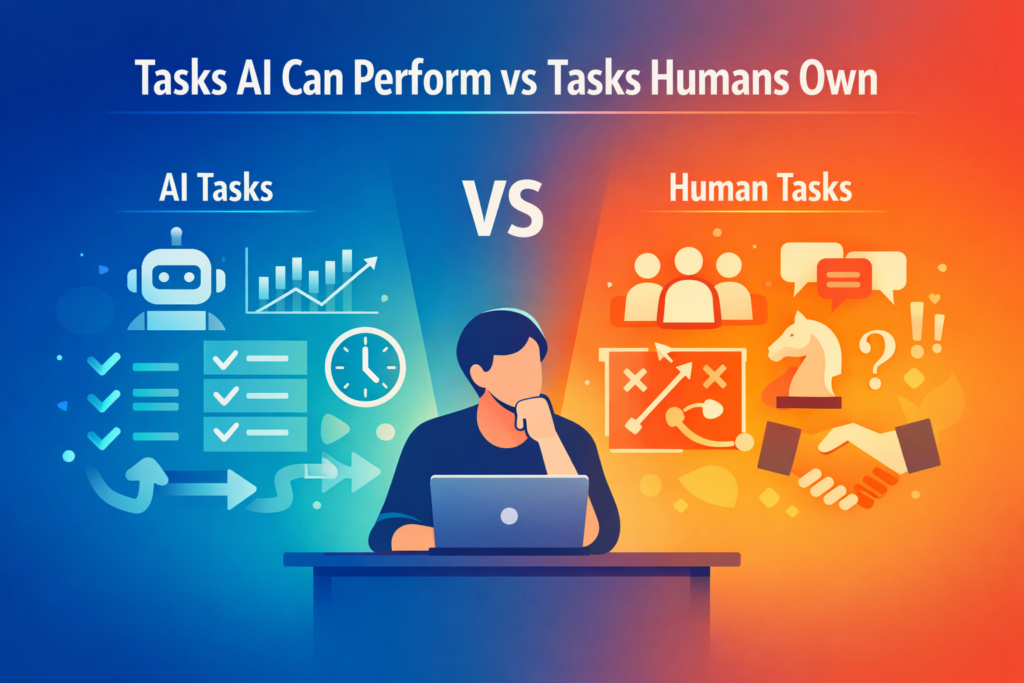
Understanding task ownership helps answer whether project managers can be replaced by AI.
1. Tasks AI Handles Well
AI performs best when tasks are data-driven and repeatable.
- Deadline predictions based on past projects
- Workload distribution across teams
- Progress tracking and alerts
- Pattern recognition across risks and delays
These areas benefit from speed and scale.
2. Tasks AI Cannot Replace
Some responsibilities require human judgment and trust.
- Team leadership and motivation
- Conflict resolution
- Strategic decision-making
- Stakeholder communication and negotiation
These tasks depend on context, emotion, and accountability.
| Function | AI Capability | Human Role |
| Planning | Predictive | Strategic |
| Reporting | Automated | Interpreting |
| Leadership | Limited | Essential |
This split explains why project managers remain necessary.
Can Project Managers Be Replaced by AI? Realistic Analysis
Many ask whether project managers will be replaced by AI. The short answer is no.
1. Why Full Replacement Is Unlikely
Project management involves people, not only tasks. AI lacks awareness of politics, emotions, and shifting priorities.
Other limits include:
- Accountability requires human ownership
- Business context changes faster than models adapt
- Decisions often rely on incomplete information
AI assists. It does not lead.
2. What Is Changing Instead
While project managers are not being replaced, their roles are evolving.
- Less time spent on manual updates
- More focus on outcomes and alignment
- Stronger emphasis on leadership skills
This shift favors project managers who adapt and learn AI-supported workflows.
Best AI Tools for Project Management (Support, Not Replacement)
Several platforms now integrate AI capabilities that support project management work.
- Jira AI helps with task prioritization and sprint planning. It analyzes past sprints to suggest optimal task assignments and identifies potential blockers.
- ClickUp AI generates summaries, drafts updates, and suggests next actions based on project activity. It helps maintain documentation with minimal manual effort.
- Monday.com AI provides workload forecasting and automated status updates. The platform flags projects at risk and recommends resource adjustments.
- Asana Intelligence offers smart goals, workflow recommendations, and predictive timeline adjustments based on team performance patterns.
- Notion AI assists with documentation, meeting notes, and knowledge management. It helps teams maintain organized project information.
These tools enhance efficiency but require human direction. They work best when project managers use them as decision support rather than decision makers.
👉 If you want a deeper comparison, feature breakdowns, and use cases, explore our complete guide to AI tools for project management on BetterBizTools.
Risks of Relying Too Much on AI in Project Management
1. Key Risks to Watch
Can ai replace a project manager when risks arise? The answer reveals why human oversight remains critical.
- Over-automation creates brittleness. When every process runs automatically, small errors cascade into larger problems. Teams lose the ability to intervene quickly.
- Poor data quality undermines AI predictions. If your historical data contains errors or biases, AI will perpetuate these problems in its recommendations.
- Bias in predictions can favor certain team members or project types. AI trained on limited data may not represent your current reality.
- Reduced human oversight leads to missed signals. When people trust AI completely, they stop questioning recommendations or verifying outputs.
AI errors scale fast when unchecked.
2. Trust and Governance Considerations
Responsible use supports EEAT principles.
- Clear human approval processes
- Transparent AI recommendations
- Strong data protection standards
- Vendor security compliance
AI should support trust, not weaken it.
How Project Managers Can Future-Proof Their Careers
1. Skills That Matter More With AI
The integration of project management and ai changes which skills provide the most value.
- Leadership and communication become more important as tactical work gets automated. Your ability to inspire, guide, and align teams differentiates you from AI capabilities.
- Business strategy skills help you frame projects in terms of organizational goals. You need to connect daily work with business outcomes.
- Change management expertise grows in value as AI adoption accelerates. Teams need guidance navigating new tools and processes.
- AI literacy means understanding what AI can and cannot do. You need enough knowledge to evaluate tools and interpret their outputs.
2. How to Work With AI, Not Against It
Smart project managers embrace AI as a productivity multiplier.
Use AI insights, not assumptions. Let data inform your decisions, but combine it with your knowledge of team dynamics and business context.
Combine data with experience. AI might predict a task will take three days based on historical averages, but you know your team just learned a new framework. Adjust accordingly.
Stay tool-agnostic. Learn principles that transfer across platforms rather than becoming dependent on specific software. Technologies change, but core project management skills remain valuable.
Conclusion — AI Changes the Role, Not the Responsibility
AI improves speed, accuracy, and visibility. It does not replace leadership, ownership, or trust. Project managers remain central to delivery. Their role shifts toward strategy, coordination, and decision-making.
Teams that combine AI tools with skilled project managers deliver stronger results.
👉 Explore expert project management blogs on BetterBizTools
👉 Download our Free Business Toolkit for templates and workflows
Follow BetterBizTools:
Facebook | LinkedIn | Instagram | Pinterest
FAQs — People Also Ask
+
+
+
+
+
+