
Disclaimers: Hey! Just so you know, this article contains ClickFunnels vs GetResponse in 2025 affiliate links to tools I genuinely recommend. If you purchase through these links, I may earn a small commission at no extra cost to you. This helps keep the site running and allows me to continue providing free, helpful content. I only recommend tools I’ve personally used or thoroughly researched.
Ever felt stuck choosing between two big tools that both claim to be the best for your business? That was me back in 2023. Now, in 2025, after two years of testing GetResponse vs ClickFunnels, I’ve seen all the updates, quirks, and wins. If you’re exploring GetResponse vs ClickFunnels 2.0 or looking for a solid ClickFunnels alternative, this guide will help you decide.
In this expert comparison, I’ll walk you through everything you need to know about ClickFunnels vs GetResponse in 2025—from features to pricing, real-world performance to automation workflows, and my personal experiences building high converting sales funnels and managing email campaigns.
This isn’t just about features—it’s about which tool will really support your small business or startup’s marketing efforts in a fast-moving digital world.
ClickFunnels vs GetResponse: Quick Overview
Let’s start ClickFunnels or GetResponse with a bird’s-eye view.
ClickFunnels is designed with one thing in mind—creating sales funnels that convert. It’s a robust sales funnel builder loaded with tools to turn leads into loyal buyers.
GetResponse, on the other hand, is a more all-in-one automation tool. It blends powerful email marketing features, landing page building, and even webinar hosting.
| Feature | ClickFunnels | GetResponse |
| Core Focus | Sales funnels and conversions | Email marketing and automation |
| Strength | High converting funnel building | Email campaigns, webinars, automation |
| Free Trial | 14-day free trial | 30-day free trial |
| Best For | Agencies, product sellers | Solopreneurs, service-based businesses |
| Interface | Visual drag-and-drop funnel editor | Smooth email and landing page workflow |
| Webinar Support | 3rd party integration required | Native webinar hosting |
If you’re launching funnels daily, ClickFunnels might be your soulmate. If you’re managing full-blown marketing campaigns with emails, webinars, and automations, GetResponse could be your secret weapon.
Read Also: ClickFunnels vs Leadpages: Best Choice for 2025
ClickFunnels vs GetResponse: Feature-by-Feature Breakdown
ClickFunnels vs GetResponse isn’t just a comparison—it’s about finding the right fit for how you build, automate, and grow your online business. Let’s start.
Email Marketing Features
Email marketing is where GetResponse shines. It gives you detailed segmentation, drag-and-drop email design, advanced autoresponders, and robust analytics for your email campaigns. Plus, if you’re considering a GetResponse alternative for advanced funnels, this is where ClickFunnels might enter as a strong contender — but for email-focused automation, GetResponse stays ahead.
ClickFunnels does have Follow-Up Funnels, but in my experience, it feels like an add-on rather than a full suite. It’s decent for transactional messages or sequences tied directly to funnel actions, but for newsletters or detailed audience targeting? GetResponse wins hands down.
Sales Funnel Builder & Landing Page Builder
ClickFunnels is the king of sales funnel building. Their interface is built around the funnel concept—from landing page builder to upsells and downsells. You can create a full conversion funnel in under 30 minutes if you know what you’re doing.
GetResponse’s conversion funnels are more linear and less visual. They’re good for basic funnel flows, but they lack the depth and flexibility ClickFunnels gives you. However, if you’re searching for a ClickFunnels alternative that’s more budget-friendly and integrates wider marketing tools, GetResponse is worth a closer look.
New to funnel building? Consider taking the One Funnel Away Challenge to master the fundamentals before diving into ClickFunnels.
Marketing Automation Tools & Workflows
Both platforms have automation workflows, but their execution is very different.
In GetResponse, automation feels like art—you can create visual, condition-based flows that branch out based on user behavior. For instance, I once set up a re-engagement campaign that brought back 23% of inactive users just by tracking clicks inside emails.
ClickFunnels’ automation is less flexible, though it’s improving. It’s more about setting up sequences than building full campaigns. If deep marketing automation tools are part of your strategy, GetResponse is the smarter pick.
Webinar Hosting & Engagement
This is where GetResponse gives ClickFunnels a solid punch.
With GetResponse, you can invite people to a webinar natively. I’ve hosted over 50 webinars through it—no integrations needed. It’s seamless.
ClickFunnels requires third-party integrations like Zoom or WebinarJam. That’s not a dealbreaker, but it does mean more cost and configuration time.
A/B Testing & Split Test Capabilities
ClickFunnels is built for split test junkies. You can test headlines, layouts, CTAs—anything—and track results inside the platform. I ran a test once on a checkout page and increased conversions by 17% in three days.
GetResponse does have A/B testing, but it’s more for emails and less for pages or full funnels. If conversion optimization is your game, ClickFunnels is more powerful here.
Data-Driven Hook
GetResponse vs ClickFunnels: Key Differences (Tested & Compared)”
After testing both platforms, here’s how they stack up in critical categories—from email campaigns to funnel flexibility.
| Feature Category | ClickFunnels | GetResponse |
| Email Marketing | Basic with Follow-Up Funnels | Advanced segmentation, autoresponders, analytics |
| Sales Funnel Builder | Best-in-class for full conversion funnels | Simple funnels, more limited in flexibility |
| Landing Page Builder | Powerful with upsells, downsells, split testing | Drag-and-drop builder for landing pages |
| Marketing Automation | Basic automation tied to funnels | Visual workflows with conditional logic |
| Webinar Hosting | Requires integrations like Zoom or WebinarJam | Native webinar functionality |
| Split Testing | Strong A/B testing for funnels and pages | Limited to email testing |
| User-Friendliness | Powerful but with a steeper learning curve | Beginner-friendly, intuitive UI |
| Support & Community | Active Facebook group, decent live chat | Fast support, detailed help center |
Pricing Comparison Table – GetResponse Plans vs ClickFunnels
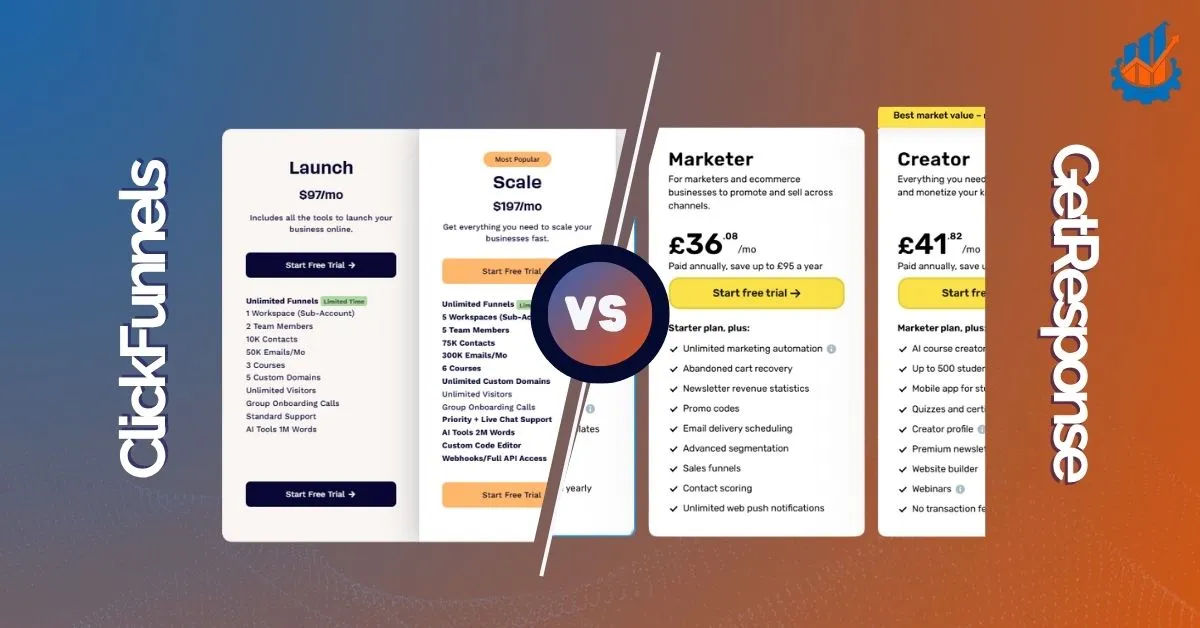
Here’s a snapshot of the current plans and offers for both tools in 2025:
| Plan | ClickFunnels (2025) | GetResponse (2025) |
| Entry Plan | $147/month | $19/month |
| Mid Plan | $197/month | $59/month |
| Premium | $297+/month | $119+/month |
| Free Trial | 14-day free trial | 30-day free trial |
Insights:
- ClickFunnels pricing is higher, but it’s built around one powerful idea: creating high converting sales funnels.
- GetResponse plans/prices are more accessible, especially for small business owners.
- Both platforms offer free trials, so you can test before you commit.
Read Also: Powerful Email Marketing for Small Business (Proven 2025 Tips)
Conversion Optimization: My Experience with A/B Testing & Funnels
I remember launching a product funnel with ClickFunnels that didn’t perform well on day one. I used the built-in split test feature to test the headline and CTA button. Within 48 hours, conversions jumped by 20%. That kind of control is invaluable.
With GetResponse, I ran a cold traffic email campaign using its email marketing features and automation workflows. I added a re-engagement series based on open rate, which lifted click-through by 34%.
The takeaway? ClickFunnels helps optimize your funnel building fast, while GetResponse helps improve overall marketing efforts across email and beyond.
Ease of Use: Which One’s More User Friendly?
Both tools (ClickFunnels vs GetResponse) have improved in 2025, but here’s what I’ve noticed:
- GetResponse feels smoother for beginners. From setting up email campaigns to creating a simple landing page builder, it’s intuitive.
- ClickFunnels is powerful but has a learning curve. Its drag-and-drop builder is great, but if you’re not technically inclined, it may feel overwhelming at first.
In my first few months with ClickFunnels, I spent hours watching tutorials. With GetResponse, I was sending automated emails within minutes.
Integrations, Support & Scalability
Integrations:
- Both tools integrate with CRMs, Stripe, Zapier, Shopify, and more.
- ClickFunnels is more focused on sales funnel builder integrations.
- GetResponse covers webinar platforms, ecommerce tools, and social ads.
Support:
- Both have live chat. GetResponse’s support tends to be faster.
- ClickFunnels has a very active Facebook group community, which can be helpful.
Scalability:
- ClickFunnels scales great for agencies or product-based funnels.
- GetResponse scales best for businesses running multi-channel campaigns.
GetResponse vs ClickFunnels: Which Tool Is Best for Your Business in 2025?
For Small Businesses & Solopreneurs
If you’re just starting out and need an affordable, easy-to-use platform for email and funnels, GetResponse is the smart bet. Its GetResponse plans/prices are budget-friendly, and it’s more user friendly for beginners.
For Agencies & Marketers
If your focus is strictly funnel building, upselling, and pushing conversions hard, ClickFunnels delivers a suite made for you. It’s especially powerful for product launches, info-products, and services with multi-step buyer journeys.
My Final Thoughts: ClickFunnels vs GetResponse
GetResponse vs ClickFunnels, or even GetResponse vs ClickFunnels 2.0, isn’t just theory—it’s based on real experience. After years of testing, tweaking, and optimizing, here’s my take:
- Choose ClickFunnels if you’re laser-focused on building high converting sales funnels, running split tests, and managing end-to-end sales experiences.
- Choose GetResponse if you want a full marketing automation tool with powerful email marketing features, webinar tools, and broader campaign capabilities.
If you’re still undecided, start a free trial of both. That’s what I did in the beginning, and it gave me all the clarity I needed.
Take Action: Test Both Platforms
Don’t let analysis paralysis hold you back. Here’s your action plan:
Step 1: Start your ClickFunnels free trial and build a simple sales funnel.
Step 2: Try GetResponse’s 30-day trial and set up an email automation sequence.
Step 3: Take the One Funnel Away Challenge to learn advanced funnel strategies regardless of which platform you choose.
Step 4: Choose the platform that felt more natural for your workflow and business goals.
The best tool is the one you’ll actually use consistently. Both ClickFunnels and GetResponse have created successful online businesses — the difference is finding which one empowers you to take action.
FAQs – ClickFunnels vs GetResponse
+
+
+
+
+
+