
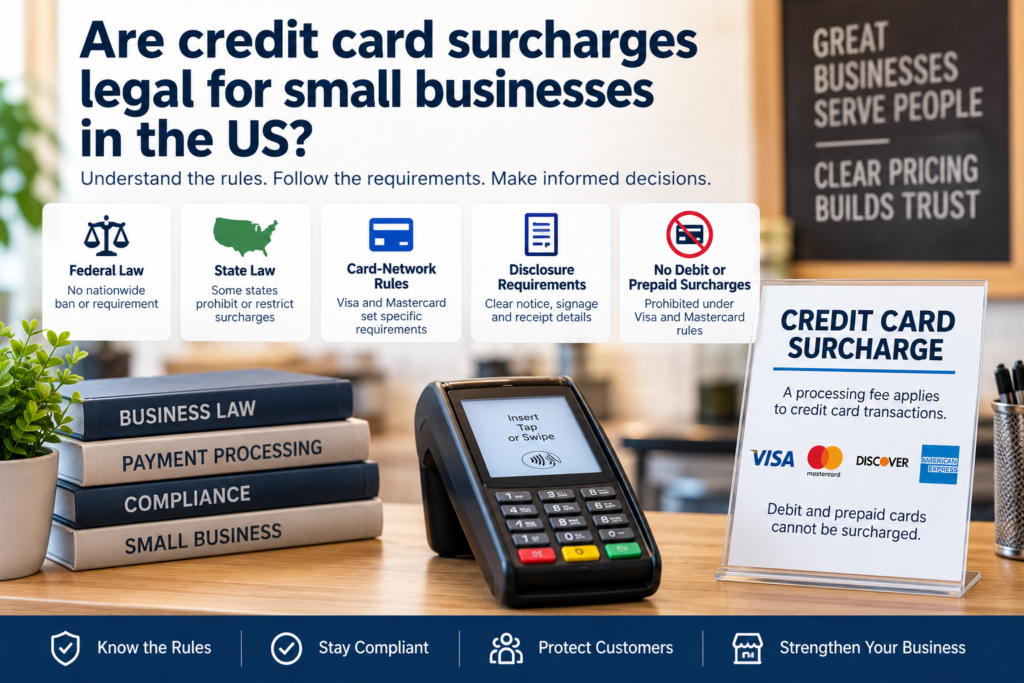
The short answer is:
In much of the United States, yes, but only under specific card-network rules and applicable state law.
A credit card surcharge is not simply a fee a business can add whenever it wants.
A small business considering surcharging has to satisfy several layers at the same time:
- the rules of the card brands it accepts
- the law in the state where the transaction occurs
- disclosure requirements
- limits on how much can be charged
- restrictions on which cards can be surcharged
The most important rule to understand first is also the clearest:
Do not surcharge debit or prepaid cards.
That remains prohibited under Visa and Mastercard rules even when a debit card is processed through a credit-routing option.
For credit cards, legality is only one part of the analysis. A merchant also needs to check the surcharge cap, advance-notice requirements, customer disclosures, receipt requirements, and any state-specific restrictions that apply to the transaction.
This article provides general educational information, not legal advice. State laws and card-network rules can change, so merchants should verify their specific requirements before implementing a surcharge program.
Table of Contents
ToggleWhat is a credit card surcharge?
A credit card surcharge is an additional amount a merchant adds when a customer chooses to pay with a credit card.
For example, if the posted price is:
$100
and the merchant adds a:
3% credit card surcharge
the customer pays:
$103
That is different from posting two prices in advance or offering a discount from a regular posted price.
The terminology matters because surcharge, dual pricing, and cash discount are not interchangeable concepts.
Federal law, state law, and card-network rules are different things
One reason surcharge information online becomes confusing is that several different rule systems are often blended together.
Card-network rules
Visa and Mastercard have their own rules governing when and how merchants may surcharge their credit cards.
Those rules are contractual requirements tied to card acceptance.
A state may not prohibit surcharging, but a merchant can still violate Visa or Mastercard rules by implementing the program incorrectly.
State law
States can impose additional restrictions or prohibit surcharging.
That means a merchant cannot rely solely on a processor telling them that its surcharge program is “Visa compliant.”
The merchant must also satisfy applicable state law.
Federal law
There is not one simple federal rule saying that ordinary merchants may or may not surcharge credit cards everywhere in the United States.
Much of the modern surcharge framework developed through changes to card-network rules and litigation rather than through one nationwide merchant-surcharge statute.
That is why merchants should avoid statements like:
“Surcharging is legal in all 50 states.”
That is not a safe generalization.
Visa credit card surcharge rules
Visa currently permits credit card surcharging in the U.S. where allowed by applicable law, but merchants have to follow Visa’s requirements.
Visa surcharge cap
Visa states that a merchant’s surcharge cannot exceed its cost of accepting the credit card.
Visa also limits the surcharge to a maximum of:
So if the merchant’s actual cost of acceptance is 2.6%, a 3% surcharge would exceed the stated cost-of-acceptance limit.
If the actual cost is 3.5%, Visa’s 3% maximum becomes the limiting factor.
Visa advance notice
Visa’s current U.S. merchant page says merchants must notify their acquirer 30 days before they begin surcharging.
That means surcharging is not something a merchant should simply switch on in the POS system one afternoon.
Visa credit cards only
Visa states that U.S. surcharging applies only to credit transactions.
Visa debit and prepaid cards cannot be surcharged.
Visa disclosure
Visa’s published materials require disclosure at the point of entry and point of sale, along with separate identification of the surcharge on the transaction receipt.
Mastercard credit card surcharge rules
Mastercard also allows surcharging of its credit cards where applicable law permits it.
Mastercard surcharge cap
Mastercard states that the surcharge cannot exceed the merchant’s cost of Mastercard credit acceptance.
It also sets an absolute maximum of:
4%
That does not mean every merchant can simply charge 4%.
If the merchant’s actual acceptance cost is lower, that lower amount governs.
Mastercard advance notice
Mastercard currently requires a merchant to give at least 30 days’ advance notice to both Mastercard and its acquirer before implementing a surcharge.
This is an important operational difference from Visa’s current public page, which directs merchants to notify the acquirer.
Mastercard credit cards only
Mastercard explicitly prohibits surcharges on:
Debit Mastercard
and
Mastercard prepaid cards.
Mastercard disclosure
Mastercard requires clear customer disclosure and requires the surcharge amount to appear on the transaction receipt.
Why most merchants should not simply use 4%
A merchant might hear:
“Mastercard allows 4%, so we can surcharge 4%.”
That conclusion is incomplete.
Visa’s current maximum is 3%.
And both Visa and Mastercard tie the allowed surcharge to the merchant’s actual acceptance cost.
So a business accepting multiple brands needs a program designed around the applicable rules, not whichever maximum number sounds most attractive.
A blanket 4% surcharge on all credit cards can create problems immediately when Visa transactions are involved.
Can you surcharge debit cards?
No, not under Visa and Mastercard’s current U.S. rules.
This is one of the most important distinctions in the entire topic.
A debit card does not become a credit card simply because the customer selects a credit option at the terminal.
The underlying card product remains debit.
That means a compliant system needs to identify the card type and suppress the surcharge when the transaction uses an ineligible debit or prepaid product.
A sign saying:
“3% fee on all card payments”
does not solve that problem if the system actually applies the fee to debit cards.
Which states prohibit credit card surcharges?
This is where merchants should be especially careful with online lists.
Current primary statutes confirm explicit surcharge prohibitions in at least:
Connecticut
Connecticut law currently says a seller may not impose a surcharge based on the method of payment. The statute also separately allows discounts for payment by cash, debit card, check, or similar means.
Massachusetts
Massachusetts General Laws currently state:
“No seller in any sales transaction may impose a surcharge” on a customer choosing a credit card instead of cash, check, or similar payment.
Maine
Maine’s current Consumer Credit Code says a seller may not impose a surcharge on a cardholder choosing to use a credit or debit card instead of cash, check, or similar means. It distinguishes a discount from a surcharge.
This is also why BetterBizTools should not publish a 50-state surcharge table unless every state is individually reverified.
State statutes change, litigation changes enforceability, and a table can become stale while still looking authoritative.
What about California?
California deserves its own explanation because the answer is more nuanced than simply “banned” or “allowed.”
California’s Attorney General explains that the state enacted a credit-card surcharge prohibition in 1985.
After litigation, a federal court held that the law could not be enforced against the businesses that brought the case, and the Attorney General says it generally applies that decision to similarly situated merchants.
California also has its newer SB 478 Honest Pricing Law.
That law generally requires advertised prices to include mandatory charges.
However, the California AG specifically says that a credit-card processing fee generally does not have to be included in the advertised price if the customer can avoid the fee by choosing another payment method, such as cash. If credit card payment is the only option, the fee becomes mandatory and must be included in the advertised price.
So California should not be reduced to:
“California bans surcharges.”
Nor should it be reduced to:
“Anything goes in California.”
Merchants operating there should check the current California AG guidance and, where material, obtain legal advice for the exact program structure.
New York has its own price-display rules
New York provides another example of why state-specific rules matter.
The New York Attorney General says merchants may charge customers paying by credit card a higher price, but they must display the higher credit-card price or display both the credit and cash prices.
The merchant cannot merely advertise a lower cash price and then announce at checkout that a percentage fee will be added.
So even when the economic result looks similar, how the price is presented can determine whether the program complies with state requirements.
Surcharge versus dual pricing versus cash discount
These terms should not be treated as synonyms. For the broader processor-selection framework, see How to choose a credit card processor for a small business.
Credit card surcharge
A surcharge starts with a regular price and adds an additional fee when the customer pays by credit card.
Example:
Regular price: $100
Credit-card surcharge: 3%
Credit-card total: $103
This structure is directly subject to card-network surcharge requirements and applicable state surcharge law.
Cash discount
A genuine cash discount starts with the regular posted price and reduces that price for a customer who pays using an eligible non-card payment method.
Example:
Regular posted price: $103
Cash discount: $3
Cash total: $100
Whether a specific implementation qualifies legally as a discount depends on how the program is structured and disclosed.
Simply calling a fee a “cash discount” does not automatically make it one.
Dual pricing
Dual pricing displays two prices in advance.
For example:
Cash price: $100
Card price: $104
The customer sees both prices before selecting a payment method.
This differs operationally from adding an unexpected fee at checkout.
But the phrase dual pricing is not a magic exemption from every card-network or state-law requirement.
The actual implementation matters.
Is 4% dual pricing the same as a 4% surcharge?
No.
A traditional 4% surcharge means an additional 4% fee is being added to the regular price when a credit card is used.
That would exceed Visa’s current 3% surcharge maximum.
A program marketed as 4% dual pricing generally claims to use two pre-disclosed prices instead of adding a surcharge at checkout.
Those are different structures.
But merchants should not assume that merely calling a program “dual pricing” automatically makes every implementation compliant.
The price presentation, payment methods, state law, card-brand rules, and processor configuration still matter.
The label does not determine the legal result.
What merchants should check before surcharging
Before changing how card costs are presented to customers, verify:
- Whether surcharging is permitted under the law of the state where you are operating or selling.
- The current rules of every card brand you accept.
- Your actual cost of credit-card acceptance.
- The maximum surcharge allowed under the applicable network.
- Whether your processor or acquirer has received the required advance notice.
- Whether Mastercard notification is required for your program.
- Whether your POS or gateway can prevent surcharging debit and prepaid cards.
- Whether signage and checkout disclosures meet network and state requirements.
- Whether the surcharge is shown properly on receipts.
- Whether ecommerce transactions into other states create additional requirements.
- Whether your merchant agreement imposes additional rules.
Your merchant statement can help establish the processing-cost side of this analysis.
See How can I read and understand my merchant statement? for the method used to calculate actual processing costs.
Before changing how those costs are presented to customers, a written review of your current processing structure can help establish what the card acceptance itself is costing you.
Customer disclosure matters
Surcharging should not be a surprise at the end of the transaction.
Visa and Mastercard both require disclosure to the customer.
For an in-person merchant, that can include signage before checkout and disclosure at the point of sale.
For ecommerce, the customer needs to see the surcharge before completing the purchase.
The receipt must also clearly identify the surcharge.
State law can impose additional requirements beyond the network rules.
Ecommerce businesses have an extra problem
A local merchant may primarily need to understand the law of one state.
An ecommerce business may sell into many states.
That can make surcharge compliance significantly more complicated.
A program that is permissible for one customer location may be restricted for another.
The merchant also needs technology capable of:
- identifying debit and prepaid cards
- applying eligible credit surcharges
- handling state-specific restrictions where necessary
- showing the fee before checkout
- itemizing it on the receipt
This is a stronger reason to avoid “just turn on 3%” implementations.
Processor marketing is not legal advice
Surcharge and dual-pricing programs are frequently marketed using phrases such as:
“free processing”
“zero-cost processing”
or
“eliminate processing fees.”
Those are commercial descriptions.
They do not replace the merchant’s obligation to follow applicable law and card-network rules.
Be cautious if anyone tells you:
- surcharging is legal everywhere
- you can surcharge every card
- 4% is always permitted
- no advance notice is necessary
- debit cards can be included
- calling a program “dual pricing” eliminates all compliance obligations
A merchant should understand what the program actually does, not just what the sales material calls it.
Should you surcharge customers?
That is a separate question from whether you can surcharge them.
A merchant may decide not to surcharge because of:
- customer experience
- competitive positioning
- average ticket
- card mix
- operating margins
- checkout friction
- the complexity of maintaining the program
Another merchant may decide the structure makes sense.
Before choosing, understand your actual processing cost rather than relying only on a quoted percentage.
See Compare credit card processing fees for small business accounts for the comparison method.
And if you are evaluating different underlying processor pricing structures, see Which payment processors offer interchange plus pricing plans?
The safest answer is specific, not universal
So, are credit card surcharges legal for small businesses in the US?
In many jurisdictions, yes.
But the merchant still has to satisfy:
state law + card-network rules + disclosure requirements + card-type restrictions
Visa currently limits U.S. credit surcharges to the lower of the merchant’s cost of acceptance or 3%.
Mastercard currently limits them to the merchant’s applicable acceptance cost, subject to a 4% absolute cap.
Neither allows surcharging debit or prepaid cards.
And some states still prohibit or impose their own restrictions on surcharging.
That means the correct implementation depends on where the merchant operates, which cards it accepts, and how its payment system is configured.
This article is general information and is not legal advice. Verify current requirements with the applicable card networks, your acquirer, state authorities, and qualified counsel when necessary before implementing a surcharge program.
Want the full merchant processing guide?
This article covers one part of the payment-processing picture. iTrust Merchant’s free guide brings the major questions together in one place so you can better understand pricing, fees, merchant statements, processor choices, account holds, and other issues that can affect your business.
→ Download the Free Merchant Processing Guide
Explore more merchant services resources for small businesses on BetterBizTools.
FAQ
Are credit card surcharges legal in the United States?
They are permitted in many states, but merchants must comply with applicable state law and card-network requirements. Some states prohibit or restrict them.
How much can I surcharge on a Visa card?
Visa currently limits U.S. credit-card surcharges to the lower of the merchant’s cost of acceptance or 3%.
How much can I surcharge on a Mastercard?
Mastercard caps the surcharge at the merchant’s applicable credit-card acceptance cost, with an absolute maximum of 4%.
Can I surcharge a debit card?
Not under Visa or Mastercard’s U.S. surcharge rules. Debit and prepaid cards are excluded from surcharging.
Can I surcharge a debit card if the customer selects credit?
No. The card remains a debit product even if it is routed differently.
Do I have to notify my processor before surcharging?
Visa currently says merchants must notify their acquirer at least 30 days before beginning. Mastercard requires at least 30 days’ advance notice to Mastercard and the acquirer.
Which states prohibit credit card surcharges?
Connecticut, Massachusetts, and Maine currently have explicit statutory surcharge prohibitions. Other states may impose additional restrictions or price-display requirements, so merchants should verify their own state rather than relying on a static national list.
Is surcharging legal in California?
California’s current framework is more nuanced. The Attorney General says the old surcharge prohibition generally is not enforced against merchants similarly situated to the plaintiffs in Italian Colors, while current price-transparency rules still regulate how mandatory fees and prices are advertised.
Is a cash discount the same as a surcharge?
No. A surcharge adds an amount to the regular price for credit-card use. A genuine cash discount reduces the regular posted price for another payment method.
Is dual pricing the same as surcharging?
Not necessarily. Dual pricing generally displays separate cash and card prices in advance. Whether a specific program triggers surcharge or other legal requirements depends on how it is actually implemented.
Can I simply charge 4% on all card transactions?
No. Visa’s current U.S. surcharge limit is 3%, debit and prepaid cards cannot be surcharged, and state law can impose additional restrictions.
About the author
Lindsey Harris works in merchant services and helps business owners better understand payment processing, merchant statements, processing costs, and provider options. He is the founder of iTrust Merchant, where businesses can request a written second opinion on their merchant processing statement.