
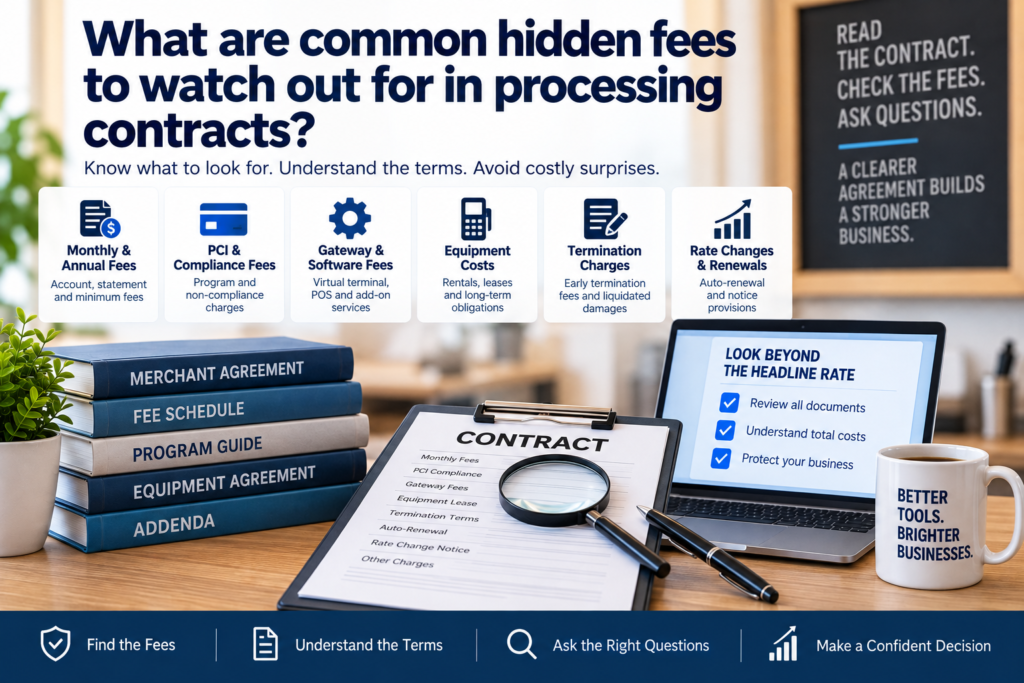
The phrase hidden fees makes it sound as if processing companies always conceal charges from merchants.
That is usually too simplistic.
Many processing costs are disclosed somewhere.
The problem is that the merchant may only read the application or pricing page while the actual terms are spread across:
- a merchant application
- a program guide or terms and conditions
- a fee schedule
- an equipment agreement
- a gateway agreement
- software terms
- addenda
- monthly statement notices
So when asking what are common hidden fees to watch out for in processing contracts?, the better question is:
What am I agreeing to, where is each cost disclosed, and which charges deserve a closer look?
That distinction matters because not every processing fee is improper.
Some are real costs.
Some are negotiable.
Some are duplicated.
Some are easy to overlook.
And some use labels that make them sound less negotiable than they really are.
Processing fees are often not truly hidden, but they can be spread across multiple documents and easy to miss. Common charges to review include monthly fees, annual fees, PCI fees, gateway charges, batch fees, equipment costs, software fees, chargeback fees, minimums, and termination-related costs. The key is to identify what each fee covers, where it was disclosed, and whether you are actually using the service.
Table of Contents
ToggleNot every “hidden fee” is actually hidden
A useful way to evaluate processing charges is to place them into five categories.
1. Legitimate and disclosed
These are real charges for services the merchant actually uses and that are disclosed in the agreement.
Examples might include:
- a gateway fee for an ecommerce business
- a monthly POS software subscription
- a chargeback-handling fee
- a reasonable account fee
A fee existing does not automatically make it a problem.
2. Disclosed but easy to miss
This is probably the largest category.
A fee may appear:
- deep in the program guide
- in a separate fee schedule
- in an equipment agreement
- in an addendum
- as a formula instead of a dollar amount
- in the notices section of a merchant statement
The merchant technically agreed to it but may never have realized it was there.
3. Negotiable
Some fees are real but can often be reduced or removed as part of the commercial agreement.
These can include processor markup and certain:
- monthly fees
- statement fees
- batch fees
- annual fees
- gateway charges
- PCI-program fees
- minimums
- termination provisions
Whether a particular processor will negotiate them depends on the account.
4. Unnecessary or duplicated
This category deserves questions.
Examples might include:
- a gateway fee when the merchant does not use a gateway
- two different gateway charges
- a PCI compliance-program fee and a PCI non-compliance fee being charged at the same time
- equipment fees for equipment the merchant already owns
The issue is not the name.
The issue is whether the merchant is paying twice or paying for something it does not use.
5. Misleadingly labeled
Some fee names sound as though they must come from Visa, Mastercard, a regulator, or another outside party.
Examples can include vague labels such as:
regulatory fee
network access fee
technology fee
compliance fee
Those names do not automatically mean the charge is improper.
But the processor should be able to explain:
Who receives this money, what does it pay for, and where is it disclosed?
Interchange is not a hidden processor fee
This distinction needs to be made early.
Interchange is not processor markup.
Neither are legitimate card-network assessments.
Those are underlying costs associated with card acceptance.
Processor markup is a separate layer.
That is why a merchant should not look at every unfamiliar Visa or Mastercard line and conclude the processor invented it.
For the full statement-side method, see How can I read and understand my merchant statement?
The goal is to separate genuine network cost from processor-controlled cost.
Where are processing fees actually disclosed?
A merchant services agreement may be more than the document you signed.
Publicly available program guides illustrate this structure. Bank of America currently provides merchants a separate Fiserv Program Guide, and Fiserv-style guides state that the guide forms part of the Merchant Processing Agreement.
Before signing, ask for the entire contract package.
The merchant application
This is usually the document merchants pay the most attention to.
It may show:
- processing rates
- business information
- banking information
- signatures
- some headline fees
But it may not contain every contractual term.
The program guide or terms and conditions
This document can contain some of the most important provisions in the relationship.
Look for:
- contract term
- renewal provisions
- termination requirements
- early termination costs
- liquidated-damages formulas
- reserve rights
- chargeback liability
- rate-change rights
- notification methods
- dispute procedures
- assignment provisions
This is one of the most important documents to request before signing.
The fee schedule
The fee schedule may contain charges not emphasized in the sales conversation.
Check every recurring and situational item.
The equipment agreement
This can be especially important because the equipment agreement may be a separate contract from the processing agreement.
Cancelling processing does not necessarily cancel an equipment obligation.
The gateway agreement
If you process online, by invoice, or through a virtual terminal, gateway pricing may be governed separately.
Check:
- monthly gateway fee
- per-transaction fee
- term
- cancellation terms
- portability
Software and POS agreements
Processing may be only one part of the total cost.
The POS or software system may have its own:
- monthly subscription
- per-location charges
- per-terminal charges
- feature modules
- cancellation terms
That needs to be included when comparing processors.
Addenda
Additional services can come with additional contracts or pricing.
Examples include:
- dual-pricing programs
- ACH
- recurring billing
- invoicing
- Level 2 or Level 3 processing tools
- loyalty programs
- specialized high-risk terms
The main processing application may not show those costs.
Common fees merchants overlook on statements
Some fees are easy to miss because each one appears small.
Over time, they add up.
Examples include:
- monthly account fee
- statement fee
- annual fee
- PCI program fee
- PCI non-compliance fee
- gateway fee
- batch fee
- authorization fee
- AVS fee
- monthly minimum
- chargeback fee
- retrieval fee
- instant-funding fee
- equipment charge
- software fee
- account closure fee
The question to ask for each is:
What is this, where did I agree to it, and am I actually using the service?
What is a monthly minimum?
A monthly minimum is commonly misunderstood.
It does not necessarily mean:
“You must process at least $X in card volume.”
It can instead mean the processor expects a minimum amount of certain processing fees each month.
If the calculated fees fall below that minimum, the merchant may pay the difference.
That can make a low-volume or seasonal account more expensive than the headline rate suggests.
If a quote contains a monthly minimum, ask exactly how it is calculated.
Early termination fees can be more complicated than one number
Merchants often look for a line such as:
Early termination fee: $___
But there are at least two very different ways an agreement can calculate exit costs.
Flat early termination fee
A flat ETF is a predetermined amount charged when the merchant cancels before the end of the contract term.
The advantage is predictability.
The merchant can see the maximum amount.
Liquidated damages
Liquidated damages use a formula rather than a simple fixed number.
A contract might calculate the amount using some combination of:
average monthly processing fees × months remaining
The exact formula depends on the agreement.
That creates a very different economic result.
If a business has grown significantly and still has many months remaining, the amount calculated under a formula can be materially larger than a flat termination fee.
The important thing is not to assume the number printed next to “termination” is necessarily the entire exit calculation.
Look for phrases such as:
liquidated damages
remaining monthly fees
average monthly charges
or
whichever is greater
The legal enforceability of a particular clause depends on the agreement and applicable law. A merchant facing a significant termination demand should obtain appropriate legal advice rather than relying on an internet article.
Watch for “whichever is greater”
This phrase deserves special attention.
Imagine an agreement says the termination amount is:
$395 or liquidated damages, whichever is greater.
A quick scan might leave the merchant thinking:
My maximum exit cost is $395.
That is not what the sentence means.
The liquidated-damages calculation could control instead.
So when reviewing a contract, do not stop when you find the first dollar amount.
Read the full termination section.
Auto-renewal can affect your exit cost
A processing agreement may renew automatically if the merchant does not cancel during a specified notice window.
The important questions are:
- What is the original term?
- Does it renew automatically?
- For how long?
- How far in advance must I cancel?
- How must cancellation be delivered?
- Does the termination provision apply during the renewed term?
Put the renewal date on your business calendar.
Do not rely on remembering it years later.
Equipment leases can survive the processing contract
This is one of the largest contract mistakes merchants can make.
A processing agreement and an equipment lease can be two different legal agreements.
You may cancel the merchant account and still owe the equipment leasing company.
Before signing equipment terms, ask:
Am I buying, renting, or leasing this equipment?
Then ask:
Who owns the equipment?
Who is the contract with?
What is the total amount I will pay?
Is the lease cancelable?
Can the equipment be used with another processor?
The monthly payment can look small while the total obligation is much larger.
Whenever possible, compare the total lease obligation against the cost of purchasing the equipment outright.
For the broader processor-selection framework, see How to choose a credit card processor for a small business.
“Free equipment” still deserves a contract review
Free can mean several things.
The processor may genuinely provide equipment at no upfront cost.
But there may still be conditions such as:
- minimum contract term
- required processing volume
- return requirements
- higher processing pricing
- equipment replacement fees
- proprietary hardware
The important question is not whether the equipment costs $0 today.
It is:
What obligation is attached to receiving it?
Contract buyout offers need their own fine print
A new processor may offer to reimburse termination costs if you switch.
That can be useful.
But do not assume “we will buy out your contract” means every possible obligation is covered.
Ask for the buyout terms in writing.
Specifically ask whether it includes:
- flat early termination fees
- liquidated damages
- equipment lease balances
- closure fees
- software obligations
- required proof of payment
- maximum reimbursement amount
Do not cancel your existing account based on a verbal buyout promise.
PCI fees are not all the same
PCI-related charges can represent different things.
PCI compliance program fee
This may pay for:
- a compliance portal
- validation tools
- security services
- scanning services
- assistance completing requirements
That can be a legitimate service.
PCI non-compliance fee
This is different.
It may be charged when required validation has not been completed.
PCI SSC confirms that there are different Self-Assessment Questionnaires for different merchant environments and that merchants should work with their acquirer or other compliance-accepting entity to determine which validation requirements apply.
PCI DSS applies to merchants regardless of business size, although the specific validation requirements can differ.
If you see a non-compliance fee, do not simply pay it indefinitely.
Find out what requirement remains incomplete.
Can both PCI fees appear?
Potentially, because the terms can refer to different things.
A processor might charge for access to a PCI compliance program while separately charging a merchant for remaining non-compliant.
That does not automatically mean the charges are incorrect.
But if both appear, ask:
What does each fee cover?
What do I need to complete to remove the non-compliance fee?
Is the program fee recurring even after compliance is complete?
Gateway and software charges can exceed the processing difference
Suppose Processor A is estimated to cost $60 less per month in transaction fees.
But Processor A requires:
$85 per month in software
while the current processor does not.
The cheaper processing quote is not actually cheaper.
This is why processing comparisons need to include the whole payment stack.
See Compare credit card processing fees for small business accounts for the complete comparison method.
Network fees versus processor padding
One of the harder things to detect is markup hidden behind the name of a legitimate network fee.
You may see statement terms associated with real Visa or Mastercard costs.
That does not automatically mean the amount being charged is exactly the underlying network amount.
The processor may pass through:
the correct fee at the correct cost
or it may add markup.
The only reliable way to know is to compare the rate shown on the statement with the card network’s current published schedule.
This is especially important on pricing presented as pass-through or interchange-plus.
See Which payment processors offer interchange plus pricing plans? for how that pricing model is supposed to work.
Again:
A legitimate network assessment is not a hidden fee.
The question is whether it is being passed through accurately.
Tiered pricing can hide cost in the pricing structure
Tiered pricing commonly separates transactions into categories such as:
- qualified
- mid-qualified
- non-qualified
The headline rate may represent only the qualified category.
If much of the merchant’s actual volume falls into the more expensive categories, the effective processing cost can be much higher than the advertised rate.
That is not necessarily a separate hidden fee.
It can be a limitation of the pricing structure itself.
The useful questions are:
What determines each tier?
How much of my volume lands in each one?
What are the rates for every tier?
Non-qualified pricing is not the same as a network downgrade
These terms are often confused.
A processor-defined non-qualified tier is part of a tiered pricing structure.
A card-network interchange downgrade can happen when a transaction does not meet certain network qualification requirements.
Those are different problems.
One may be addressed through pricing.
The other may require changing how transactions are processed.
Blog #5 explains that distinction in more detail.
Read the notices section of your merchant statement
One of the easiest places to miss a pricing change is the monthly statement itself.
Processors can communicate account changes through notices or messages.
That means a merchant may never receive a phone call saying:
“Your pricing is changing.”
The notification may already be on the statement.
Get into the habit of reading the notices section every month.
If your effective rate increases while processing activity remains relatively stable, check recent notices.
For the statement-analysis method, see How can I read and understand my merchant statement?
How to review a processing contract before signing
Before signing, work through this checklist.
1. Request every document
Ask for:
the merchant application
the complete program guide or terms and conditions
the full fee schedule
the equipment or lease agreement
the gateway agreement
all addenda
Ask in writing whether any other documents form part of the agreement.
2. Find the contract term
Identify:
- starting date
- ending date
- renewal terms
- cancellation window
- required cancellation method
3. Find every exit cost
Search for:
- early termination
- liquidated damages
- account closure
- remaining minimums
- equipment obligations
4. Identify every fixed fee
Add:
- monthly fees
- gateway
- software
- equipment
- PCI
- annual fees divided by 12
This gives you a realistic monthly baseline.
5. Check equipment separately
Do not assume it is included in the processing contract.
6. Read the rate-change provisions
Ask:
- Can pricing change?
- How will I be notified?
- Where will notice appear?
7. Read reserve and hold provisions
These can matter even if they are never used.
For more on the difference between a reserve, hold, payout restriction, and termination, see Why would a payment service provider freeze my business account?
8. Confirm how processor markup works
If the quote is interchange-plus, confirm:
interchange and network costs pass through at cost
and
processor markup appears separately
9. Put every promise in writing
If the salesperson says:
“We will waive that fee.”
the written contract should reflect it.
Do not rely only on a verbal assurance.
10. Model the full agreement
Apply the complete pricing structure to an actual month of your business.
Do not compare the headline rate alone.
How to audit an existing processing account
You can use the same method after you are already processing.
Start with two or three recent statements.
Then get your current contract package.
For every charge:
- identify the fee
- find it in the agreement
- confirm the amount matches
- determine what service it pays for
- check whether you use that service
- look for duplicates
- review statement notices for increases
- verify network-fee rates where appropriate
- calculate your effective rate
- check your current contract and equipment exit obligations
Then make a list of questions.
Ask the processor in writing.
A clear explanation may reveal that the fee is legitimate and the arrangement remains competitive.
That is useful information too.
If you have a written proposal from another processor, compare the proposal against your current statement and contract package before signing. If you would like another set of eyes specifically on the pricing and fee structure, you can request a merchant statement review through iTrust Merchant.
The goal is not automatically to find a reason to switch.
It is to know what you are paying and what you are agreeing to.
Common mistakes when reviewing processing contracts
Avoid these:
- Reading only the merchant application.
- Never requesting the program guide.
- Assuming a flat ETF is the entire termination cost.
- Ignoring liquidated-damages language.
- Missing an auto-renewal deadline.
- Signing an equipment lease without calculating the total obligation.
- Assuming cancelling processing cancels the equipment agreement.
- Relying on verbal fee waivers.
- Calling legitimate interchange a hidden fee.
- Assuming every network-sounding fee is charged at network cost.
- Ignoring statement notices.
- Paying avoidable PCI non-compliance fees indefinitely.
- Leaving gateway and software costs out of comparisons.
- Assuming a buyout offer covers every exit obligation.
- Assuming switching is always the correct answer.
A fair contract at a reasonable total cost is also a valid outcome.
Want the full merchant processing guide?
This article covers one part of the payment-processing picture. iTrust Merchant’s free guide brings the major questions together in one place so you can better understand pricing, fees, merchant statements, processor choices, account holds, and other issues that can affect your business.
→ Download the Free Merchant Processing Guide
Explore more merchant services resources for small businesses on BetterBizTools.
FAQ
What are the most common hidden fees in credit card processing contracts?
Commonly overlooked charges include monthly account fees, annual fees, PCI fees, gateway charges, batch fees, monthly minimums, equipment charges, software subscriptions, chargeback fees, and termination-related costs.
Are processing fees really hidden?
Often they are disclosed but difficult to locate. Important terms may appear in a program guide, fee schedule, equipment contract, addendum, or statement notice rather than on the main application.
What is a merchant services program guide?
A program guide is a document containing terms and conditions that may form part of the merchant processing agreement. It can contain provisions involving termination, reserves, disputes, pricing changes, and other account obligations.
What is the difference between an early termination fee and liquidated damages?
A flat early termination fee is a predetermined dollar amount. Liquidated damages use a contractual formula that may depend on previous fees and the time remaining in the agreement.
Can an equipment lease continue after I cancel my processor?
Yes, if the equipment agreement is a separate contract. Review the equipment contract independently from the merchant processing agreement.
Is a PCI fee legitimate?
It can be. A PCI program fee may pay for compliance tools or services. A PCI non-compliance fee may be charged when required validation is incomplete. Ask what each charge covers.
Is interchange a hidden processing fee?
No. Interchange is an underlying card-acceptance cost associated with the issuing bank and card network. Processor markup is a separate layer.
How can I tell whether a network fee is marked up?
Compare the rate or amount shown on the merchant statement with current published card-network information. A legitimate network-fee name does not by itself prove the amount is being passed through at cost.
Why did my processing costs increase without anyone calling me?
Pricing changes may be disclosed in the notices or messages section of your merchant statement. Read those notices regularly and compare effective costs month to month.
What should I request before signing a merchant services agreement?
Request the complete merchant application, program guide or terms and conditions, full fee schedule, equipment agreement, gateway agreement, and all applicable addenda.
Should I change processors if I find extra fees?
Not automatically. First determine whether the charges are legitimate, negotiable, duplicated, or inconsistent with the agreement. Then compare total switching cost against the potential benefit.
About the author
Lindsey Harris works in merchant services and helps business owners better understand payment processing, merchant statements, processing costs, and provider options. He is the founder of iTrust Merchant, where businesses can request a written second opinion on their merchant processing statement.