
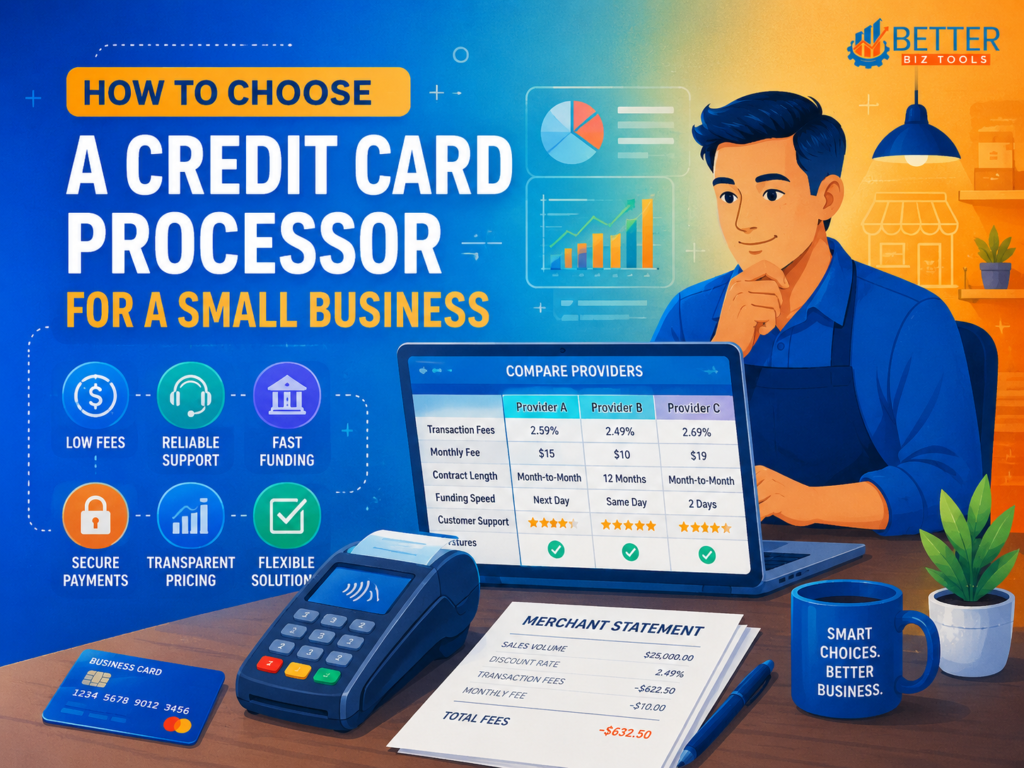
Learning how to choose a credit card processor for a small business starts with looking beyond the lowest advertised rate.
The right processor should fit how your business accepts payments, how much you process, how quickly you need access to your money, what software or hardware you use, and whether the processor is comfortable with your type of business.
That means there is no single processor that is automatically best for every small business.
A newer business processing a few thousand dollars a month may value simplicity and easy setup. A business processing significantly more may care more about transparent pricing, funding policies, account stability, integrations, contract terms, and support.
The goal is to compare the total cost and overall fit, not just the percentage shown on a pricing page.
Compare processors based on how you accept payments, your processing volume and average ticket, total pricing structure, funding speed, contract terms, equipment, integrations, underwriting fit, and customer support. The best comparison is based on how the processor would actually work for your specific business.
Table of Contents
ToggleStart with how your business accepts payments
Before comparing processors, identify how customers actually pay you.
Your business may need:
- countertop credit card terminals
- mobile payments
- ecommerce payments
- recurring billing
- invoicing
- card-on-file payments
- payment links
- a payment gateway
- integrations with accounting or industry software
A processor that works well for a retail store may not be the best choice for an ecommerce business, contractor, professional-service company, subscription business, or company that primarily sends invoices.
Your monthly processing volume and average transaction size matter too.
The processor should understand what your business sells, how customers pay, and what your normal transaction activity looks like.
Understand the different credit card processing pricing models
Knowing how you will be charged makes it much easier to compare offers.
Flat-rate pricing
Flat-rate processors generally charge one published percentage plus a per-transaction fee.
The main benefit is simplicity. You do not need to understand dozens of card types and interchange categories to estimate your costs.
For some newer or lower-volume businesses, that simplicity can make sense.
But simple pricing does not automatically mean lowest total cost. Whether flat-rate pricing is a good fit depends on your monthly volume, average ticket, card mix, and how transactions are accepted.
Interchange-plus pricing
With interchange-plus pricing, the underlying card-network costs are passed through and the processor adds a disclosed markup.
You may see an offer written something like:
Interchange + processor percentage + per-transaction fee
This can make it easier to see what portion of the cost belongs to the processor.
Interchange-plus may work well for some businesses, particularly those that want more pricing transparency, but it is not automatically cheaper for every merchant.
Monthly fees, transaction volume, ticket size, and card mix still matter.
Tiered pricing
Tiered pricing groups transactions into categories such as qualified, mid-qualified, and non-qualified.
This structure can make it harder to understand why one transaction costs more than another.
If you are offered tiered pricing, ask exactly how transactions are assigned to each tier and what your actual total cost is expected to be.
Dual pricing, surcharge, and cash discount programs
These terms are sometimes used as though they mean the same thing, but they do not.
A surcharge adds an additional amount to certain credit-card transactions.
A cash discount generally starts with a posted card price and offers customers a discount for paying with cash.
Dual pricing displays different cash and card prices before the customer chooses how to pay.
If you are considering one of these programs, ask the provider exactly how the program works, how pricing is displayed, and what compliance requirements apply.
Compare your effective rate, not just the advertised rate
One of the most useful numbers for comparing credit card processing is your effective rate.
The basic formula is:
Total processing fees ÷ total card sales × 100
For example, if your business processed $25,000 in card sales during a month and your total processing-related fees were $750:
$750 ÷ $25,000 × 100 = 3% effective rate
That gives you a much clearer picture than simply looking at an advertised processing percentage.
Your total costs may include:
- processor markup
- monthly fees
- authorization charges
- gateway fees
- PCI-related fees
- statement fees
- transaction fees
- chargeback fees
- other recurring charges
If you already process credit cards, reviewing two or three months of merchant statements can give you a much better baseline for comparing a new offer.
Ask for the complete fee schedule
Do not stop at asking:
“What rate do you charge?”
Ask for the complete fee schedule in writing.
Questions should include:
- Is there a monthly account fee?
- Is there a statement fee?
- Are there PCI-related fees?
- Are there authorization fees?
- Are there gateway fees?
- Is there a monthly minimum?
- What is the chargeback fee?
- Are there annual fees?
- Are there equipment fees?
- Are there cancellation fees?
- Can the processor change its markup later?
A processor should be able to explain what each fee is and when it applies.
Review the contract and equipment terms
A low processing rate can become much less attractive if the agreement is difficult or expensive to leave.
Find out whether the contract is:
- month-to-month
- multi-year
- automatically renewed
- subject to an early termination fee
- subject to liquidated damages
Also ask about the equipment separately.
Is the terminal:
- purchased
- rented
- leased
- provided by a third party
- reusable if you switch processors?
A business may have flexible processing terms while still being tied to a separate equipment agreement.
It is worth knowing that before you sign.
Ask how and when you get your money
Processing fees matter, but access to cash can matter even more.
Ask:
- When are card transactions deposited?
- What is the daily batch cutoff?
- Is next-day funding available?
- What happens on weekends and holidays?
- Is faster funding available for an additional fee?
- Under what circumstances can funds be held?
- Can the account be placed on reserve?
- What happens if your processing volume suddenly increases?
No processor can realistically promise that funds will never be reviewed or held.
Processors manage financial risk, and account agreements generally allow them to review unusual activity under certain circumstances.
The important thing is understanding those circumstances before there is a problem.
Understand underwriting and account stability
Not every payment account is approved in the same way.
Some payment platforms allow businesses to begin accepting payments very quickly and perform additional risk reviews after processing has started.
Traditional merchant accounts generally involve more underwriting before the account is approved.
Neither structure is automatically better.
The right choice depends on the business.
Underwriters may consider:
- industry
- time in business
- monthly processing volume
- average transaction size
- processing history
- chargeback history
- delivery timeframes
- refund policies
- website information
- previous merchant-account issues
A company that accepts large deposits, sells future services, processes unusually large transactions, or operates in an industry considered higher risk may need a processor that specifically supports that business model.
Be accurate about your expected volume and average ticket when applying.
A large difference between the activity described on an application and the transactions actually being processed can lead to additional review.
Make sure the processor supports your industry
“Small business” covers thousands of different business models.
The right processing setup for a neighborhood store may be completely different from one for:
- ecommerce
- travel
- subscriptions
- professional services
- high-ticket transactions
- future-delivery businesses
- businesses considered higher risk
Being categorized as high risk does not automatically mean a business cannot accept cards.
It may mean the business needs a processor with experience underwriting that industry, along with different pricing or reserve requirements.
Check integrations, hardware, and payment tools
The cheapest payment processor is not helpful if it does not work with the way you run your business.
Ask whether the system supports:
- your ecommerce platform
- accounting software
- recurring payments
- invoicing
- secure card-on-file payments
- mobile transactions
- multiple locations
- reporting and exports
- your preferred hardware
If you sell online, you may also need to evaluate the payment gateway separately from the merchant account.
Evaluate customer support before you need it
Payment processing usually feels simple when everything is working.
Support becomes important when something goes wrong.
Before signing up, ask:
- Is live phone support available?
- What are the support hours?
- Do you receive a dedicated contact?
- Who handles funding issues?
- Who handles chargebacks?
- Who handles hardware problems?
- How are urgent account reviews escalated?
If a large batch fails to settle or your funds are delayed, knowing who to contact can matter more than a small difference in transaction pricing.
Understand your PCI responsibilities
Businesses that accept card payments have responsibilities related to payment-card security.
The PCI Security Standards Council maintains PCI DSS, the security standard used throughout the card-payment ecosystem. The specific validation requirements for a merchant depend on how that business accepts and handles card data.
Ask your processor:
- What am I responsible for?
- Which PCI validation process applies to my business?
- Do I need to complete a Self-Assessment Questionnaire?
- Are there PCI compliance fees?
- Are there non-compliance fees?
- Who helps me complete the required validation?
Be careful when comparing surcharge and customer-fee programs
If a processor proposes a program that passes some processing costs to customers, ask exactly what type of program is being offered.
Do not assume surcharge, cash discount, and dual pricing are interchangeable.
For traditional U.S. Visa credit-card surcharging, Visa currently limits surcharges to credit cards, not debit or prepaid cards, and applies additional notification and disclosure requirements. Visa’s current U.S. surcharge cap is generally the lower of the merchant’s applicable cost or 3%.
Mastercard‘s published U.S. guidance allows surcharging up to the merchant’s applicable cost of acceptance, subject to an absolute 4% ceiling.
State laws can add additional restrictions or disclosure requirements.
If you are considering any customer-facing pricing program, make sure you understand exactly how your provider structures it and what rules apply to your business.
Questions to ask a credit card processor before signing
Use the same questions when comparing different providers:
- What pricing model are you offering me?
- What is your processor markup?
- What are all recurring and transaction-level fees?
- Is there a contract term or early termination fee?
- Can pricing change during the agreement?
- How quickly will my funds be deposited?
- Under what circumstances can funds be held or a reserve imposed?
- What are the chargeback fees?
- What are my PCI responsibilities and fees?
- Is there a monthly minimum?
- Do you support my industry?
- Does your system integrate with the software I use?
- Do I own the equipment?
- Can the hardware or gateway move with me if I change processors?
- Who do I contact when I need help?
Common mistakes small businesses make when choosing a processor
Watch for these mistakes:
- choosing based only on the advertised rate
- failing to calculate the effective rate
- ignoring monthly or miscellaneous fees
- signing an equipment lease without understanding the total cost
- failing to read cancellation terms
- selecting a processor that does not understand the business model
- underestimating expected processing volume on the application
- ignoring funding and reserve policies
- assuming “no monthly fee” automatically means lowest cost
- never reevaluating processing after the business grows
A processing setup that made sense when your business processed $5,000 per month may not necessarily be the best setup once the business is processing $25,000 or $50,000 per month.
How to choose a credit card processor for a small business
Start with your actual business rather than a processor’s advertisement.
Know:
- how much you process
- your average transaction size
- how customers pay
- what software and hardware you need
- how quickly you need funding
- whether your industry has additional underwriting considerations
Then compare processors using the same criteria.
The best processor is not necessarily the company advertising the lowest percentage.
It is the processor whose total cost, contract terms, payment tools, funding policies, underwriting approach, and support fit the way your business actually operates.
If you already accept cards, your current merchant statement is one of the best places to start because it shows what you are actually paying today.
You can also explore more merchant services resources for small businesses on BetterBizTools.
Not sure what you’re actually paying?
Your current merchant statement can help you compare processing costs more accurately.
If you would like a second set of eyes on your statement, you can request a merchant statement review through iTrust Merchant to better understand your current processing setup before deciding whether a change makes sense.
Want the full merchant processing guide?
This article covers one part of the payment-processing picture. iTrust Merchant’s free guide brings the major questions together in one place so you can better understand pricing, fees, merchant statements, processor choices, account holds, and other issues that can affect your business.
→ Download the Free Merchant Processing Guide
FAQ
What is the best credit card processing for small business?
There is no single best processor for every small business. The right choice depends on processing volume, average transaction size, payment channels, pricing structure, contract terms, integrations, funding needs, support, and underwriting fit.
What is the cheapest credit card processing for small business?
The cheapest advertised rate is not necessarily the lowest total cost. Compare the complete fee schedule and calculate your effective rate using your actual processing history.
Which credit card processing is cheapest for small business?
It depends on the business. Flat-rate pricing may be simple and competitive for some merchants, while interchange-plus or another pricing model may make more sense for others.
Is flat-rate or interchange-plus cheaper for a small business?
Neither is automatically cheaper. Processing volume, card mix, average ticket, monthly fees, processor markup, and how customers pay all affect the result.
Do I need a merchant account, or can I use Square, Stripe, or PayPal?
Either approach can be appropriate. Payment aggregators can be convenient for some businesses, while other merchants may benefit from a separately underwritten merchant account.
About the author
Lindsey Harris works in merchant services and helps business owners better understand payment processing, merchant statements, processing costs, and provider options. He is the founder of iTrust Merchant, where businesses can request a written second opinion on their merchant processing statement.