
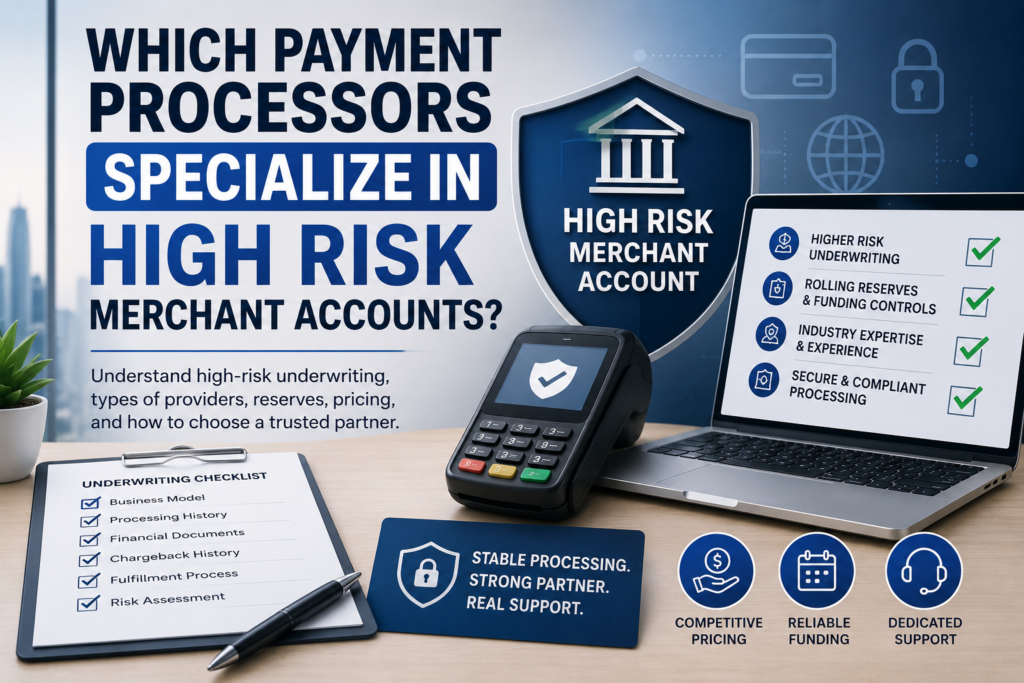
A business looking for a high-risk merchant account will usually find a long list of companies claiming to specialize in difficult approvals.
The harder question is determining which one actually has the right underwriting relationships for your business.
That is because a company advertising itself as a “high-risk payment processor” may not be the bank or processor that ultimately carries the account.
Many are independent sales organizations, or ISOs, that work with acquiring banks and processors willing to underwrite particular industries.
So when asking which payment processors specialize in high risk merchant accounts, the better question is:
Which provider has a legitimate acquiring relationship that supports my specific business model, transaction profile, and risk history?
That distinction can make the difference between a stable merchant account and another shutdown.
There is no permanent list of high-risk processors that fits every business. The right provider needs an acquiring relationship that currently supports your industry, processing volume, ticket size, transaction method, fulfillment model, chargeback history, and other underwriting factors.
Table of Contents
ToggleWhat does high risk merchant account mean?
A high-risk merchant account is generally a merchant account underwritten for a business that presents more potential financial exposure to the acquiring bank than a standard merchant.
That does not mean the business is illegal, dishonest, or poorly managed.
The classification is about financial risk.
An acquirer may consider factors such as chargeback exposure, refund patterns, how long customers wait for products or services, average transaction size, monthly volume, regulatory requirements, and whether transactions occur online or in person.
A legitimate travel company that collects payment months before a trip can be considered high risk.
So can a contractor accepting large deposits, an ecommerce subscription business, an online coaching company, or a company selling expensive custom products.
The common factor is not reputation.
It is the possibility that the acquirer could become financially responsible if customers dispute transactions and the merchant cannot cover the losses.
High risk can mean three different things
The term gets used too broadly.
There are actually three different concepts worth separating.
A processor’s underwriting classification
This is the broadest meaning.
The processor or acquiring bank looks at your business and determines whether it falls within its normal risk appetite.
One processor may consider your business standard risk while another considers it high risk.
That is why one processor declining a business does not necessarily mean every processor will.
Card-network registration requirements
Visa and Mastercard also maintain special risk and compliance programs for certain merchant types.
These are narrower than a processor simply calling a business “high risk.”
A business can receive high-risk pricing or a reserve without necessarily belonging to a special Visa or Mastercard registration category.
Network monitoring programs
Visa and Mastercard also monitor actual merchant performance, including fraud and disputes.
Visa’s current Visa Acquirer Monitoring Program, or VAMP, monitors acquirers and merchants based on fraud and dispute activity.
Visa’s published materials show that the U.S. excessive-merchant VAMP ratio was scheduled to decrease to 1.5% effective April 1, 2026. Visa also uses a minimum count of 1,500 fraud-plus-dispute events per month for merchant-level identification in the U.S. and several other regions.
That distinction matters because many smaller merchants will never reach 1,500 monthly events.
Their processor may still impose a much lower internal dispute threshold.
Therefore, merchants should ask the processor:
What is your own internal chargeback or dispute threshold?
Do not rely only on card-network thresholds.
Which payment processors specialize in high risk merchant accounts?
There is no reliable permanent ranking of high-risk processors.
Instead, the market generally falls into several provider types.
Specialist high-risk ISOs and brokers focus primarily on merchants that ordinary processors may decline. Their value is usually their network of sponsor banks and acquiring relationships.
Acquirers and processors with high-risk programs actually carry or sponsor accounts in industries that fall outside standard underwriting.
General processors with limited elevated-risk programs may support certain higher-risk industries while prohibiting others.
Payment gateways are another part of the stack. A gateway may support high-risk merchant accounts without being the company underwriting the merchant account itself.
Offshore or international acquiring programs may serve categories that domestic acquiring banks will not support, although these arrangements can introduce additional currency, funding, contract, and legal considerations.
The provider’s website is therefore only the beginning of the evaluation.
You need to know who is actually underwriting the account.
High risk merchant account versus Square, Stripe, or PayPal
Payment facilitators such as Square, Stripe, and PayPal provide convenient onboarding for enormous numbers of businesses.
But they also maintain prohibited and restricted business lists.
A merchant whose business falls outside a payment facilitator’s risk appetite may need a separately underwritten merchant account rather than repeatedly trying different aggregator accounts.
This is especially important after a shutdown.
Opening another account under a slightly different business description does not change the underlying business model.
If Square has restricted or closed your account, see our guide on how to switch from Square to another payment processor.
If you currently use Stripe, see how to switch from Stripe to another payment processor easily.
The goal should be accurate placement, not finding another platform willing to let the transactions run temporarily.
Why businesses are classified as high risk
Some of the most common reasons have nothing to do with whether the company is legitimate.
A business may receive a high-risk classification because it accepts large deposits, delivers products or services long after payment, operates primarily online, sells subscriptions, has a high average transaction size, has a volatile processing history, operates in a heavily regulated industry, or has previous chargebacks or processor terminations.
Certain industries also have higher historical dispute rates.
An underwriter may therefore evaluate the risk of the entire category, not just the individual business.
This means two merchants with excellent operations can receive different account terms simply because they operate in different industries.
Industries commonly treated as higher risk
The exact classifications differ by processor and acquiring bank, but elevated-risk underwriting frequently appears in industries involving delayed fulfillment, subscriptions, regulated products, large tickets, or unusually high dispute exposure.
Examples include travel, events, coaching and education programs, contractors taking deposits, certain health and wellness products, subscription businesses, debt or credit-related services, telemarketing-driven sales, online luxury goods, some financial services, and regulated or age-restricted products.
Some card-network-defined categories have additional registration or monitoring requirements.
The important point is that no static internet list should be treated as universal.
Ask the prospective provider whether it currently supports your exact product, sales method, fulfillment timeline, average ticket, monthly volume, and transaction channel.
How high-risk underwriting works
High-risk merchant accounts normally involve deeper underwriting before approval.
The underwriter wants to understand the probability that customers will dispute transactions and whether the merchant has the financial capacity and operational controls to handle refunds and chargebacks.
That may require more documentation than a standard merchant account.
The process may examine business formation documents, bank statements, previous processing statements, chargeback history, website policies, fulfillment procedures, licenses, supplier relationships, and financial information.
A clean processing history can be extremely valuable.
Several months of merchant statements can show the underwriter actual transaction volume, average ticket size, refund activity, and dispute performance.
A new merchant without processing history may still be approved, but the account may begin with tighter conditions.
High risk does not always mean declined
One of the most useful ways to think about high-risk underwriting is:
Risk can often be structured rather than rejected.
An acquiring bank may approve an account with conditions such as a rolling reserve, delayed funding, a monthly processing limit, or a maximum transaction size.
Those conditions reduce the bank’s exposure.
This is why a legitimate merchant who has previously been declined should not automatically conclude that card processing is unavailable.
The merchant may simply need a provider whose acquiring relationships support that risk profile.
What is a rolling reserve?
A reserve is money held by the processor or acquiring bank as protection against potential future chargebacks, refunds, or other losses.
A rolling reserve generally means a percentage of processing volume is held and released later according to the agreement.
For example, a portion of today’s processing could be held for a specified period and released after that period if the account remains in good standing.
Reserve terms can vary significantly.
The questions that matter are not simply:
“Is there a reserve?”
They are:
How much is held? How long is it held? When is it released? Can the reserve be reduced after clean processing history? What happens to it when the account closes?
Be skeptical of anyone guaranteeing that a high-risk merchant will never have a reserve.
The acquiring bank ultimately determines underwriting conditions.
High-risk pricing can vary widely
High-risk merchant accounts usually cost more than comparable standard-risk accounts because the provider is assuming more financial and operational risk.
But there is no universal high-risk rate.
Different acquirers can view the same merchant differently.
One may require a larger reserve but offer better processing pricing.
Another may offer faster funding but higher transaction costs.
A third may decline the business entirely.
That makes written comparisons especially important.
Do not compare only one percentage.
Compare the entire fee schedule and the effective cost against your actual processing volume.
For the framework, see how to choose a credit card processor for a small business.
For high-risk businesses, stability can matter more than the lowest price
Price matters, but for some high-risk businesses it should not be the first consideration.
A merchant may find one provider offering a lower processing rate while another offers an account that is better aligned with the business model, transaction volume, ticket size, fulfillment timeline, and risk profile.
For a higher-risk business, the cost of losing the ability to accept payments can be far greater than a modest difference in processing rates.
That makes account stability part of the economic decision.
A properly underwritten account may cost more than a standard merchant account, but the more important questions may be:
- Does the acquiring bank actually support my industry?
- Is my expected volume accurately approved?
- Is my realistic maximum ticket understood?
- Are my fulfillment model and sales methods properly disclosed?
- Are the reserve and funding terms workable?
- What happens if the account is reviewed or restricted?
- Does this relationship appear structured for the way my business will actually process?
Should a high-risk business have a backup merchant account?
For some higher-risk or payment-dependent businesses, it can also make sense to discuss payment continuity with an experienced provider.
That may include maintaining a second, properly underwritten merchant account or processing relationship so the business does not depend entirely on one point of failure.
A backup account should not be used to hide transactions, avoid processing limits, evade chargeback monitoring, or move volume away from an account that is under review.
Each account should be legitimately established, accurately underwritten, and approved for the business and transactions it is expected to process.
The purpose is continuity, not circumvention.
If a secondary processing relationship is part of your plan, discuss the structure openly with the providers involved so you understand how volume should be handled and what each account is approved to process.
For some high-risk merchants, the decision hierarchy may look more like this:
Underwriting fit → Account stability → Payment continuity → Terms → Price
The cheapest account is not always the most valuable account if it cannot reliably support the business.
Ask about processing and ticket limits
High-risk approvals frequently come with an approved processing profile.
That may include a monthly volume limit and a maximum expected transaction size.
Those numbers matter.
If your account is approved for $50,000 per month and suddenly processes $150,000, the processor may review the activity.
Likewise, an account approved around a $200 average ticket may receive additional attention if it suddenly begins submitting $5,000 transactions.
That does not necessarily mean the processor acted randomly.
It can mean the actual processing activity no longer matches the profile originally underwritten.
When applying, give realistic numbers.
Do not intentionally underestimate your volume or ticket size to make an application look safer.
Previous processor shutdowns do not automatically end your options
A prior shutdown is important underwriting information, but it does not automatically mean another merchant account is impossible.
The reason for the shutdown matters.
A merchant terminated because its actual transaction volume did not match the application presents a different situation from a merchant terminated for excessive chargebacks.
Likewise, a business with an old dispute spike that can document what caused the problem and how it was corrected may present a different risk profile today.
The worst strategy is hiding the history.
Underwriters frequently review previous processing statements and termination history.
Full disclosure gives the new provider a chance to place the account correctly.
What is the Mastercard MATCH list?
Mastercard maintains MATCH Pro, a risk-information system containing information about certain merchants and owners reported after qualifying terminations.
Mastercard describes MATCH as a tool that helps acquirers evaluate additional risk before entering a merchant agreement.
Current Mastercard rules state that MATCH Pro searches information reported and stored during the past five years. Mastercard also requires acquirers to make required MATCH inquiries before certain merchant agreements are entered.
Being classified as “high risk” does not by itself mean a merchant is on MATCH.
A qualifying termination and defined MATCH reason are involved.
Likewise, being on MATCH does not mean every acquirer is legally prohibited from serving the merchant.
It does mean mainstream placement becomes significantly more difficult and requires careful underwriting.
If you believe you were placed on MATCH incorrectly, start with the acquiring institution that reported the termination rather than paying someone who guarantees they can “remove” you.
Do not hide the business model
One of the fastest ways to create another processor problem is to describe the business as something safer than it really is.
If you sell supplements, do not describe yourself merely as “online retail.”
If you operate a subscription service, disclose recurring billing.
If customers pay months before delivery, explain the fulfillment timeline.
If you have high-ticket transactions, disclose the realistic ticket size.
The merchant account needs to be underwritten for the transactions you will actually submit.
Never process through someone else’s merchant account
A desperate merchant may encounter someone offering to “run the payments through another account.”
Do not do this.
The FTC describes credit-card laundering as obtaining access to the card system through another merchant’s account without authorization from the financial institution.
A legitimate high-risk merchant account should be properly underwritten for the actual merchant.
How to tell whether a high-risk provider is legitimate
High-risk underwriting should generally involve more questions, not fewer.
A provider asking about your processing history, business model, refunds, website, ticket size, chargebacks, and fulfillment practices is not necessarily making the process difficult.
It may be doing the work required to place the account correctly.
The warning signs are the opposite.
Be cautious around providers promising guaranteed approval, instant approval regardless of industry, guaranteed no reserves, guaranteed MATCH removal, or extremely high approval percentages without qualification.
Also be cautious if a provider refuses to tell you who the acquiring bank or processor will be before you sign the final agreement.
Questions to ask a high-risk payment processor
Before agreeing to an account, ask:
- Which acquiring bank or processor will actually hold my merchant account?
- Does that acquirer explicitly support my industry and business model?
- What reserve will apply, and when is it released?
- Is there a written schedule for reviewing or reducing the reserve?
- What monthly processing volume am I approved for?
- What is my approved maximum ticket?
- What is your internal dispute or chargeback threshold?
- How quickly will deposits arrive?
- What is the complete written fee schedule?
- Is there an early termination fee or liquidated damages provision?
- Is any equipment leased?
- Is the gateway portable if I later change acquirers?
- What happens to the reserve if the account closes?
- Does my prior processing history or termination change the account terms?
- Who handles account reviews, holds, and underwriting questions after approval?
- Based on my business and risk profile, should I have a secondary processing relationship for business continuity, and are there restrictions on how it should be used?
Do not accept vague answers to questions involving reserves, caps, fees, or termination.
Those details should be reflected in the actual agreement.
Which payment processors specialize in high risk merchant accounts?
The most useful answer is not a permanent list of company names.
Look for a provider with access to acquiring banks that currently support your exact industry and transaction profile.
A legitimate specialist should be able to explain:
- why your business is considered high risk
- which underwriting conditions are likely
- what documentation is required
- what the reserve terms are
- which processor or acquiring relationship is being used
- what transaction and volume limits apply
- how chargebacks affect account stability
The provider should also be willing to tell you when it cannot place the business.
That is a much stronger sign than a website promising that everyone gets approved.
High-risk merchant processing works best when the account is structured around the business that actually exists.
The goal is not simply getting an approval.
For some higher-risk businesses, the lowest processing rate should not be the primary consideration. A properly underwritten account that fits the merchant’s actual industry, volume, ticket size, fulfillment model, and risk profile may be more valuable than a cheaper account that is less stable.
For businesses where losing the ability to accept payments would create serious disruption, payment continuity may matter as well. In some cases, that can include maintaining a second, properly underwritten merchant account or processing relationship as a legitimate backup.
A backup account should not be used to hide transactions, avoid processing limits, or move volume around to bypass risk controls. Each account should be accurately disclosed and approved for the business and transactions it is expected to process.
For some high-risk merchants, the decision hierarchy may look more like this:
Underwriting fit → Account stability → Payment continuity → Terms → Price
The goal is not just approval. It is a processing relationship that can remain stable as the business operates and grows.
Explore more merchant services resources for small businesses on BetterBizTools.
Before choosing a high-risk processor, understand what you are paying
High-risk processing offers can vary substantially.
If you already accept cards, your current merchant statement can help show your actual processing volume, effective cost, transaction size, and fee structure.
If you would like a second set of eyes on your existing processing costs before considering a change, you can request a merchant statement review through iTrust Merchant.
Want the full merchant processing guide?
This article covers one part of the payment-processing picture. iTrust Merchant’s free guide brings the major questions together in one place so you can better understand pricing, fees, merchant statements, processor choices, account holds, and other issues that can affect your business.
→ Download the Free Merchant Processing Guide
FAQ
What does a high risk merchant account mean?
It is a merchant account underwritten for a business that an acquiring bank or processor believes presents greater potential financial exposure than a standard account. It is an underwriting classification, not a judgment about whether the business is legitimate.
Why is my business considered high risk if it is legal?
Legal businesses may still create greater chargeback, refund, fulfillment, regulatory, or financial exposure for an acquiring bank. Delayed delivery, large tickets, subscriptions, card-not-present transactions, and industry history can all affect classification.
Does Square or Stripe accept high-risk businesses?
Square and Stripe maintain restricted and prohibited business policies. Some elevated-risk businesses may be supported under certain conditions while others are prohibited. Businesses outside an aggregator’s risk appetite may require a separately underwritten merchant account.
What is a rolling reserve?
A rolling reserve is a portion of processing volume held temporarily by the processor or acquiring bank to cover potential future chargebacks, refunds, or other losses. The percentage, holding period, and release terms depend on the account agreement.
Can I get a merchant account after another processor shut me down?
Possibly. The reason for the shutdown, current business model, chargeback history, financial condition, processing history, and any MATCH listing all affect placement. Disclose the history to the new underwriter rather than hiding it.
What is the MATCH list?
MATCH Pro is Mastercard’s system containing information about certain merchants and owners reported following qualifying terminations. Acquirers use it as part of merchant-risk evaluation. Current Mastercard rules search reported MATCH data from the preceding five years.
Is instant approval real for high-risk merchant accounts?
A preliminary screening may happen quickly, but a properly underwritten high-risk merchant account generally requires review of the actual business and its risk profile. Treat unconditional guaranteed-approval claims cautiously.
What chargeback ratio gets a high-risk merchant account terminated?
There is no single answer because processor and acquirer internal limits can be lower than card-network program thresholds. Ask the processor for its own written threshold and consequences.
About the author
Lindsey Harris works in merchant services and helps business owners better understand payment processing, merchant statements, processing costs, and provider options. He is the founder of iTrust Merchant, where businesses can request a written second opinion on their merchant processing statement.