
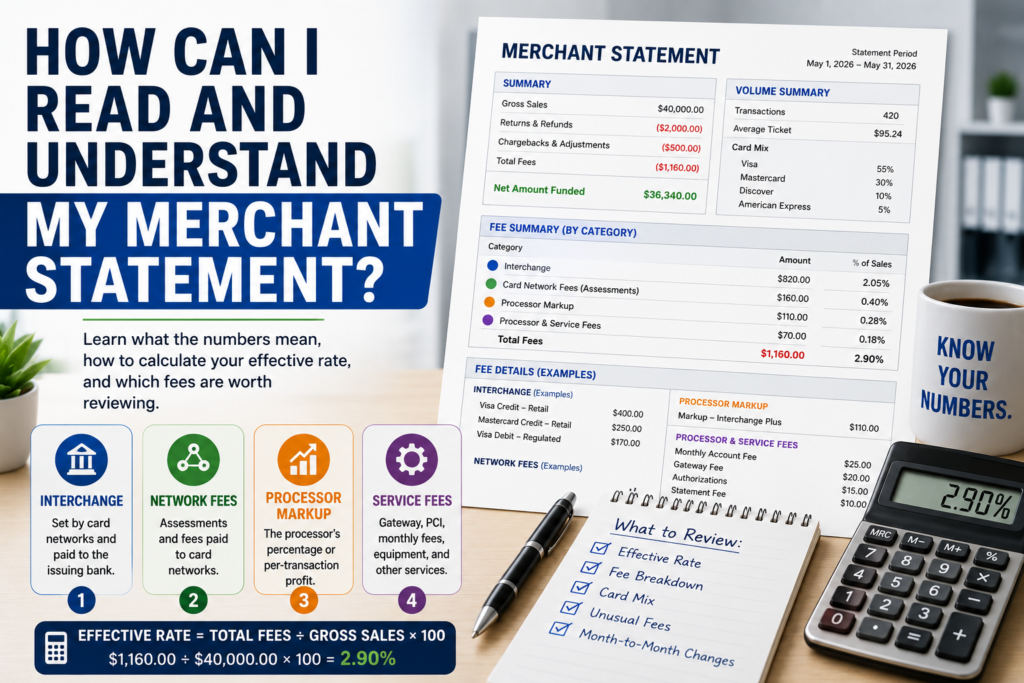
A merchant statement can look intimidating.
Depending on your payment processor, it may contain several pages of percentages, transaction counts, interchange categories, assessments, authorization charges, monthly fees, adjustments, and unfamiliar abbreviations.
But you do not need to understand every line individually to understand what you are paying.
The easier way to answer how can I read and understand my merchant statement? is to sort the information into a few basic categories.
Almost every processing cost can be placed into one of four buckets:
- Interchange
- Card-network fees
- Processor markup
- Processor-specific or service fees
Once you understand those four buckets, you can calculate your actual processing cost, identify which charges may be negotiable, and compare one processing offer against another much more accurately.
Start with the statement summary, gross processing volume, total fees, and transaction count. Then separate the charges into interchange, card-network fees, processor markup, and processor-specific fees. This makes it much easier to calculate your effective processing rate and see where your money is going.
Table of Contents
ToggleStart with the statement summary
Merchant statements do not all look the same.
A statement produced through one processing platform may organize information completely differently from another.
Even the names used for similar fees can vary.
So instead of looking for a particular page or line number, start by locating the statement’s summary information.
You will usually find some combination of:
- total card sales or processing volume
- transaction count
- refunds or credits
- chargebacks or adjustments
- total fees
- deposits or net funding
- card-brand totals
- statement period
Your first objective is simply to understand how much you processed and how much processing cost you during that period.
Everything else helps explain why.
Find your gross processing volume
Look for a figure labeled something like:
Gross sales
Amount submitted
Total sales
Processed volume
or similar language.
You want the total amount of card sales processed during the statement period before fees are deducted.
Do not calculate your processing cost using the amount deposited into your bank account.
Your deposits may already have fees, refunds, chargebacks, or reserve amounts removed.
The correct starting point for analyzing processing cost is your gross card-processing volume.
Find your transaction count and average ticket
Next, locate the total number of transactions.
If the statement does not provide an average ticket, you can calculate it:
Average ticket = Gross processing volume ÷ Number of transactions
For example, if a business processed $30,000 across 300 transactions:
$30,000 ÷ 300 = $100 average ticket
Average ticket matters because different fee structures affect businesses differently.
A processor charging a larger per-transaction fee has a greater effect on a business processing thousands of small purchases than on one processing a few large transactions.
That is one reason two businesses with the same advertised processing rate may have very different actual processing costs.
Why your deposits may not match your sales
One of the easiest merchant-statement mistakes is comparing gross sales directly with bank deposits.
The two numbers may not match for several reasons.
Refunds can reduce funding.
Chargebacks can remove money.
Reserves can temporarily hold funds.
And processors can deduct processing fees in different ways.
Daily discount billing
With daily discount billing, some processing fees are deducted before each deposit reaches your bank.
You therefore receive net deposits throughout the month.
Monthly discount billing
With monthly discount billing, you may receive gross or closer-to-gross deposits during the month and then see a larger processing-fee withdrawal later.
Neither billing method automatically costs more.
They simply make the money move differently.
That is why comparing bank deposits alone can create the impression that one processor is cheaper when the difference is actually just how fees are collected.
Sort every processing charge into four buckets
This is the most useful skill you can learn from your merchant statement.
Instead of trying to memorize dozens of fee names, sort them.
Bucket 1: Interchange
Interchange is generally the portion of a card transaction paid through the card network to the card-issuing bank.
On an interchange-plus statement, you may see numerous interchange categories associated with different types of cards and transactions.
Costs can differ based on factors such as:
- debit versus credit
- consumer versus commercial cards
- rewards or premium cards
- card-present versus card-not-present transactions
- transaction information submitted
- settlement and authorization conditions
Interchange is generally not the part of the processing price that your processor simply negotiates away.
The same transaction characteristics generally carry the applicable card-network interchange regardless of which processor handles the transaction.
What can sometimes change is how the transaction qualifies.
For example, transaction method, settlement behavior, or missing information can affect how some transactions are categorized.
Bucket 2: Card-network fees
Visa, Mastercard, Discover, and other card networks also impose various assessments and network charges.
Depending on the statement, you may encounter terms such as:
- assessments
- dues and assessments
- network fees
- brand fees
- NABU
- APF
- FANF
- data or access fees
These are separate from interchange.
The important principle is:
Interchange and legitimate network charges are not the same thing as processor markup.
Current card-network schedules can change, sometimes during regular network pricing-update cycles, so avoid judging a fee from an old article or an outdated chart.
If you want to verify a named network fee, compare the amount or rate shown on your statement with the card network’s current published information.
That comparison can become especially useful when analyzing processor markup.
Bucket 3: Processor markup
This is the layer most merchants should pay particular attention to because it is generally where the processor or sales organization earns part of its revenue.
Depending on your pricing model, markup may appear as:
- a percentage above interchange
- basis points above interchange
- a per-transaction markup
- authorization fees
- a bundled discount rate
- qualified, mid-qualified, or non-qualified rates
- other processor-added transaction charges
On a clearly structured interchange-plus statement, separating processor markup may be relatively straightforward.
On a tiered statement, it can be much harder.
And on flat-rate processing, the underlying interchange and processor spread may not be shown to you at all.
Bucket 4: Processor-specific and service fees
The final bucket contains fees for processor services, software, equipment, account administration, or other features.
You might see charges such as:
- monthly account fees
- statement fees
- gateway fees
- PCI program fees
- PCI non-compliance fees
- batch fees
- AVS fees
- chargeback fees
- retrieval fees
- annual fees
- equipment rental or lease charges
- POS software fees
- minimum monthly fees
- technology or service fees
Do not assume every fee in this category is unnecessary.
A gateway fee may be completely appropriate for an ecommerce merchant.
A software charge may pay for a POS platform the business actively uses.
A PCI-related service charge may correspond to an actual compliance service.
The better question is:
What am I paying for, do I use it, was it disclosed, and is the amount reasonable?
The network-fee padding test
One of the more useful statement checks is comparing fees labeled as card-network charges against current published network information.
Why?
Because a fee can carry the name of a legitimate network charge while still being billed at an amount above the underlying network cost.
A label alone does not prove that the entire amount is pass-through cost.
If a statement identifies something as an assessment, network access fee, or other card-brand charge, compare the stated rate with current network information.
Any unexplained difference deserves a question.
That does not automatically mean the processor did something improper.
But it helps separate genuine pass-through expenses from potential processor markup.
How to calculate your effective processing rate
Your advertised processing rate does not necessarily tell you what card acceptance actually costs your business.
Your effective rate gives you a better starting point.
Use:
Effective rate = Total processing fees ÷ Gross processing volume × 100
Suppose a business processed $40,000 during the month and paid $1,160 in total processing-related fees.
The calculation is:
$1,160 ÷ $40,000 × 100 = 2.90%
That 2.90% represents the all-in effective processing rate for that statement period.
It incorporates much more than a processor’s advertised percentage.
What should be included in total fees?
For an all-in comparison, include processing-related costs such as:
- interchange
- network fees
- processor markup
- transaction fees
- monthly fees
- relevant gateway or software processing charges
- chargeback fees
- other account fees
But distinguish fees from money that is merely being held.
For example, a reserve contribution is not the same thing as a processing expense. The money remains yours even though you temporarily cannot access it.
Likewise, the amount of a disputed transaction itself is not a processing fee, although a separate chargeback fee would be.
Do not calculate effective rate from one unusual month
One month can be distorted.
Maybe you paid an annual fee.
Maybe chargebacks spiked.
Maybe your business is seasonal.
Maybe card mix changed.
Calculate the effective rate across at least a few representative months when possible.
Then compare:
- gross volume
- total fees
- effective rate
- average ticket
- transaction count
- card mix
- fixed monthly fees
- unusual charges
Patterns are more informative than a single month’s number.
There is no universal “good” effective rate
It is tempting to ask what effective rate every merchant should be paying.
There is no honest universal number.
A business accepting mostly regulated debit cards in person has a different underlying cost structure from an online business accepting premium rewards cards.
A high-ticket B2B merchant can have a different cost structure from a coffee shop processing hundreds of small purchases.
Ecommerce, keyed transactions, international cards, commercial cards, refunds, chargebacks, and average ticket can all affect the result.
Instead of asking:
“Is my effective rate above X%?”
Ask:
“Given my actual card mix and processing method, how much am I paying above the underlying costs?”
That is a much more useful comparison.
How to identify your pricing model
Your merchant statement can often tell you what kind of pricing structure you have.
Interchange-plus
An interchange-plus statement typically shows actual interchange categories separately and then applies a processor markup.
This usually provides the clearest visibility into underlying card costs and processor margin.
Tiered or bundled pricing
A tiered statement may group transactions into categories such as:
Qualified
Mid-qualified
Non-qualified
The processor determines how transactions are grouped into those pricing buckets.
Because actual interchange may not be separately displayed, determining exact processor markup can be difficult.
Flat-rate pricing
Flat-rate pricing generally charges a consistent advertised percentage and sometimes a per-transaction fee.
Processors such as payment facilitators may provide dashboards and fee reports rather than traditional merchant statements.
The simplicity can be useful, but it also means you may not see the underlying interchange and network costs transaction by transaction.
Subscription or membership pricing
Some processors charge a monthly membership or subscription fee while passing interchange through separately and charging a smaller transaction fee.
Again, the correct comparison is the total cost, not whichever individual number sounds lowest.
For a broader comparison of these structures, see how to choose a credit card processor for a small business.
“Non-qualified” and network downgrades are not necessarily the same thing
This distinction is important.
On tiered pricing, a processor may place transactions into a non-qualified pricing bucket.
That bucket is part of the processor’s pricing structure.
Separately, card networks have interchange qualification categories that can become more expensive when transaction requirements are not met.
Those are not the same thing.
A network qualification issue may sometimes be addressed operationally through things like transaction data or settlement procedures.
A processor’s tiered pricing bucket is part of the processor’s own pricing structure.
If your statement uses the word “downgrade” or shows unusually expensive categories, determine which one you are actually looking at before deciding how to fix it.
Fees worth asking about
Some statement lines deserve questions even when they are legitimate.
PCI fees
PCI-related charges can represent different things.
One may pay for a compliance program.
Another may be a non-compliance charge because required validation was not completed.
PCI SSC explains that different Self-Assessment Questionnaires apply to different merchant environments and that merchants should work with the entity responsible for accepting their compliance validation to determine what applies.
So if you see a PCI charge, ask exactly what it represents rather than assuming all PCI fees are identical.
Statement or account fees
Ask what service the charge covers and whether there is an alternative if you receive statements electronically.
Gateway fees
These make sense for many ecommerce businesses.
They deserve investigation if you do not use the gateway or if multiple gateway charges appear without explanation.
Equipment charges
Determine whether you are buying, renting, or leasing equipment.
An equipment charge is particularly important when comparing processors because the processing agreement and equipment agreement may be separate.
Chargeback fees
Separate the amount of the disputed sale from the fee charged for handling the dispute.
If your business has elevated chargeback exposure, also monitor whether your dispute activity is approaching your processor’s internal thresholds.
For more about how underwriting and chargebacks affect elevated-risk accounts, see Which payment processors specialize in high risk merchant accounts?
Unclear “technology,” “risk,” or “regulatory” fees
Do not automatically assume these are illegitimate.
Ask what they pay for.
A processor should be able to explain a recurring charge.
Why two merchants with the same quoted rate can pay different amounts
Imagine two businesses are both told they have a 2.5% processing rate.
That does not mean their actual costs will be identical.
Their effective costs can differ because of:
- card mix
- debit versus credit usage
- premium and rewards cards
- average transaction size
- card-present versus online transactions
- transaction fees
- monthly fees
- international cards
- chargebacks
- qualification issues
- processor-specific services
This is why comparing processors by advertised rate alone can be misleading.
The merchant statement shows what actually happened.
What should you compare every month?
You do not need to perform a complete forensic audit every month.
Track a small set of numbers:
Gross processing volume
Transaction count
Average ticket
Total processing fees
Effective rate
Refunds
Chargebacks
Major changes in card mix
New fees
Any notices or pricing-change messages
If your effective rate rises while your volume and card mix remain relatively stable, investigate why.
Perhaps a new fee appeared.
Maybe the processor changed pricing.
Maybe more transactions are being placed into expensive categories.
Or perhaps your processing behavior changed.
The purpose of tracking is not to assume something is wrong.
It is to notice when something changed.
Read the notices section
Do not ignore the last page of your merchant statement.
Processors may use statement notices to communicate pricing changes, card-network updates, compliance requirements, or account-policy changes.
If your costs suddenly increase, check recent notices before assuming the change came from card mix.
A rate increase may already have been disclosed there.
What should I redact before sharing a merchant statement?
A merchant statement contains useful business information, but it may also contain sensitive information that another person does not need in order to analyze your processing costs.
Before sharing one, review it carefully.
Consider redacting:
- bank account numbers
- routing numbers
- full merchant identification numbers when unnecessary
- tax IDs or EINs
- owner personal information
- customer-identifying information in dispute sections
- any card information that is not already appropriately masked
- passwords, security information, or access credentials
Keep the information required for the analysis, including:
- statement period
- processing volume
- transaction counts
- fee names
- fee rates
- interchange information
- card-brand summaries
- chargeback counts and fees
- reserve activity
- pricing notices
Use genuine document-redaction tools rather than simply drawing a black box over sensitive text if you are creating a PDF to share.
What can a merchant statement review reveal?
A careful statement review can answer quite a few questions.
It can help reveal:
- your actual effective processing rate
- your pricing model
- processor markup when the statement provides enough detail
- card and transaction patterns affecting cost
- questionable or unexplained service fees
- possible network-fee padding
- transaction qualification issues
- changes in pricing over time
- chargeback-related costs
- whether another pricing structure may deserve investigation
It can also reveal something merchants sometimes overlook:
Your current processing arrangement may already be reasonable.
A statement review does not have to end with a recommendation to switch.
What a merchant statement cannot tell you
Your statement is important, but it is not the entire merchant-processing relationship.
It usually cannot fully tell you:
- the remaining contract term
- early termination provisions
- auto-renewal terms
- all equipment lease obligations
- future reserve-release rules
- processor support quality
- integration compatibility
- underwriting appetite
- future account-stability risk
- whether another acquirer will approve your business
That is why a lower projected effective rate somewhere else does not automatically mean you should change processors.
Your statement answers:
“What am I paying, and what is driving that cost?”
The decision to stay or switch requires a broader evaluation.
For that broader framework, see how to choose a credit card processor for a small business.
If you are moving away from an aggregator, the operational side also matters. See how to switch from Square to another payment processor or how to switch from Stripe to another payment processor easily before moving processing volume.
If you would rather have another set of eyes review the numbers, you can request a merchant statement review through iTrust Merchant. A useful review should help explain what the statement actually shows, including when the current arrangement appears reasonable rather than assuming that switching is automatically the answer.
Want the full merchant processing guide?
This article covers one part of the payment-processing picture. iTrust Merchant’s free guide brings the major questions together in one place so you can better understand pricing, fees, merchant statements, processor choices, account holds, and other issues that can affect your business.
→ Download the Free Merchant Processing Guide
Explore more merchant services resources for small businesses on BetterBizTools.
FAQ
What is a merchant statement?
A merchant statement is a periodic account report showing payment-processing activity, fees, adjustments, and other information associated with a merchant account. Exact layouts and terminology vary by processor.
How do I calculate my effective processing rate?
Divide your total processing fees for the period by your gross card-processing volume and multiply by 100.
Effective rate = Total fees ÷ Gross processing volume × 100
Use gross volume rather than net bank deposits.
What is a good effective processing rate?
There is no universal number. The appropriate comparison depends on your card mix, transaction channel, average ticket, pricing model, and other processing characteristics.
What is the difference between interchange and processor markup?
Interchange is generally paid through the card network to the card issuer according to network pricing. Processor markup is the additional amount charged by the processor or sales organization for processing and related services.
Why is my effective rate higher than my quoted rate?
The quoted rate may represent only one component of total processing cost. Interchange, network fees, per-transaction charges, monthly fees, card mix, qualification categories, and other services can increase the all-in effective rate.
What does non-qualified mean on a merchant statement?
On a tiered pricing plan, non-qualified generally refers to a processor-defined pricing bucket for transactions receiving a higher bundled rate. It should not automatically be confused with a card-network interchange qualification issue.
Why don’t my bank deposits equal my card sales?
Fees may be deducted before funding, and refunds, chargebacks, adjustments, or reserves can also reduce deposits. Daily and monthly discount billing can make otherwise similar processing costs appear differently in the bank account.
Are PCI fees legitimate?
Some PCI-related fees correspond to compliance programs or services, while others may be non-compliance charges. Ask the processor exactly what the fee represents and what validation requirements apply to your account.
Which merchant statement fees are negotiable?
Processor markup and many processor-specific service charges may be negotiable. Interchange and genuine card-network costs generally are not processor-negotiated fees.
What should I black out before sending my merchant statement to someone?
Redact unnecessary banking information, tax identifiers, personal information, customer information, credentials, and other sensitive account data while preserving processing volumes, fee details, rates, card mix, and other information required for the review.
Can a statement review tell me whether I should switch processors?
Not by itself. A statement can show what you are paying and why, but switching decisions should also consider contract terms, funding, integrations, support, underwriting fit, reserves, and account stability.
About the author
Lindsey Harris works in merchant services and helps business owners better understand payment processing, merchant statements, processing costs, and provider options. He is the founder of iTrust Merchant, where businesses can request a written second opinion on their merchant processing statement.