
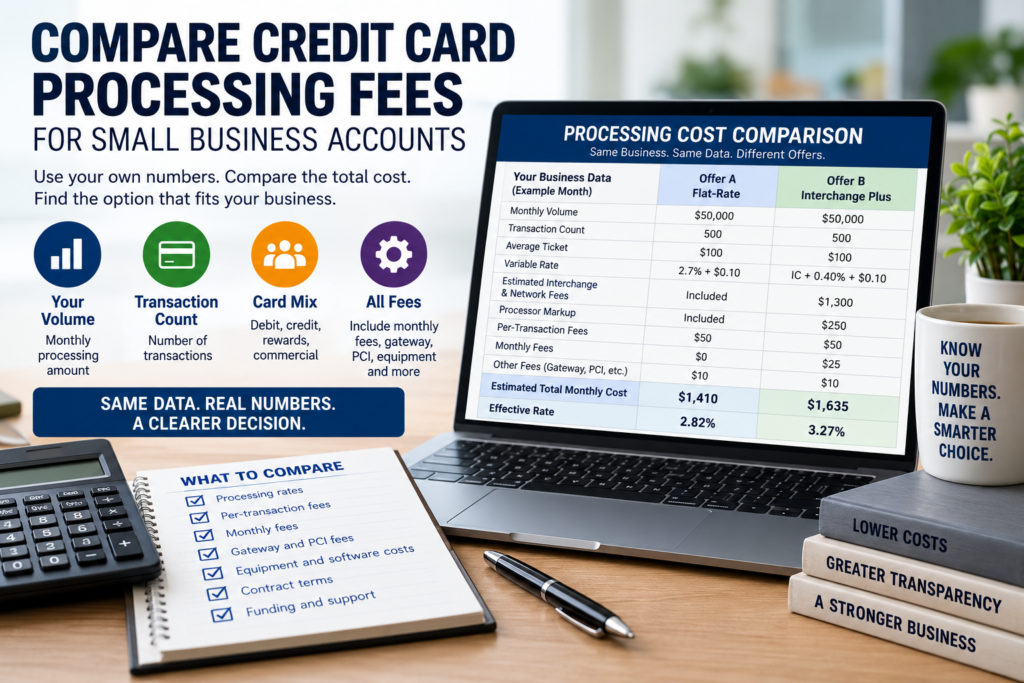
Trying to compare credit card processing fees for small business accounts can become confusing quickly.
One processor may advertise a single percentage plus a transaction fee.
Another may quote interchange plus a markup.
Another may charge a monthly membership fee with smaller transaction charges.
A fourth may offer tiered pricing with qualified, mid-qualified, and non-qualified rates.
Those numbers are not directly comparable.
The most reliable way to compare credit card processing offers is to apply each pricing structure to the same month of your own transaction data.
That means using the same:
- processing volume
- transaction count
- average ticket
- card mix
- card-present versus online volume
- refunds and chargebacks
- fixed monthly costs
Only then can you see what each offer would actually cost your business.
In other words, compare total dollars and effective processing cost using the same real-world transaction data for every provider. Headline percentages by themselves do not provide an apples-to-apples comparison.
Table of Contents
ToggleCredit card processing fees are made up of several different costs
Before comparing offers, it helps to separate processing costs into four groups.
1. Interchange and card-network costs
Interchange is generally paid through the card networks to card-issuing banks.
The amount can vary according to factors such as card type, transaction method, merchant category, and transaction data.
Card networks also impose assessments and other network charges.
These costs are different from the processor’s own markup.
For the same transaction, changing processors does not magically eliminate the applicable underlying interchange.
That is why an interchange-plus quote showing something like:
Interchange + 0.40% + $0.10
cannot be compared directly with a flat-rate quote showing:
2.7% + $0.10
The first quote describes the processor’s markup on top of underlying card costs.
The second describes a blended price intended to include those underlying costs.
They are different units.
2. Processor-controlled costs
This is where much of the actual price competition occurs.
Processor-controlled costs can include:
- percentage markup
- per-transaction markup
- authorization charges
- monthly membership charges
- tiered pricing spreads
- account fees
- processor-added network-fee markup
These costs can often be compared or negotiated.
3. Service and account costs
A processing relationship can also include charges for services such as:
- payment gateways
- PCI programs
- statements
- batches
- equipment
- POS software
- chargebacks
- retrieval requests
- annual account fees
- minimum monthly fees
- faster deposits
Some of these may be completely legitimate.
The important part is including them in your comparison.
A processor with a lower transaction rate can still cost more overall if its monthly software, gateway, equipment, or account charges are higher.
4. Your own transaction profile
The last category is not a fee at all.
It is your business.
Your processing costs are affected by:
- monthly processing volume
- number of transactions
- average ticket
- debit versus credit mix
- rewards and premium cards
- commercial cards
- international cards
- card-present versus online transactions
- keyed transactions
- refunds
- chargebacks
This is why there is no processor that is automatically cheapest for every small business.
Start with a real month, not an advertised rate
The best comparison begins with actual transaction history.
Choose a representative month and collect:
Gross processing volume
Transaction count
Average ticket
Card mix
Card-present, online, and keyed transaction volume
Total processing fees
Fixed account costs
Refund and chargeback activity
If you are not sure where to find those numbers, see How can I read and understand my merchant statement?
For seasonal businesses, one month may not be enough.
Use a normal month, a slower month, and a stronger month when possible.
That lets you see whether one pricing structure becomes more or less attractive as your volume changes.
Why average ticket matters so much
Consider two businesses that each process $30,000 per month.
Business A processes 300 transactions.
Its average ticket is:
$30,000 ÷ 300 = $100
Business B also processes $30,000, but it processes 3,000 transactions.
Its average ticket is:
$30,000 ÷ 3,000 = $10
Now imagine a processor charges a $0.20 per-transaction fee.
Business A would pay:
300 × $0.20 = $60
Business B would pay:
3,000 × $0.20 = $600
Same monthly volume.
Same processor.
Same per-transaction price.
But a $540 monthly difference because transaction count is different.
This is why comparing processors using monthly volume alone is incomplete.
Percentage fees work in the opposite direction
Per-transaction fees matter more to businesses with small tickets and large transaction counts.
Percentage fees become more important as transaction size increases.
For example, a 0.30% difference applied to $30,000 of volume equals:
$90
Applied to $150,000, the same 0.30% difference equals:
$450
So a high-ticket business may care much more about percentage markup than about a small difference in per-transaction charges.
Meanwhile, a low-ticket business can be heavily affected by every additional nickel or dime charged per transaction.
That is one reason there is no universal answer to whether flat-rate, interchange-plus, or subscription pricing is cheaper.
Flat-rate pricing
Flat-rate pricing generally combines underlying processing costs and processor margin into a simpler advertised rate.
The main advantage is predictability.
You may pay one rate for in-person transactions, another for online transactions, and another for manually entered payments.
For a smaller merchant, simplicity and low fixed costs can be valuable.
But the flat rate does not necessarily move down when your underlying interchange is inexpensive.
That becomes especially important for merchants processing a large amount of lower-cost debit transactions.
Interchange-plus pricing
Interchange-plus separates the underlying interchange from the processor’s markup.
For example, the price might be structured as:
Interchange + processor percentage markup + per-transaction markup
The advantage is visibility.
If a particular transaction has relatively inexpensive underlying interchange, the merchant receives the benefit of that lower cost rather than paying the same blended rate used for a more expensive card.
Interchange-plus plans can, however, include monthly account fees, gateway charges, PCI-related costs, or other fixed expenses.
Those fixed costs matter when volume is low.
For full pricing-model definitions, see How to choose a credit card processor for a small business.
Subscription or membership pricing
Some processors use a structure based around a larger fixed monthly fee, with interchange passed through and a smaller transaction charge.
This creates a different cost curve.
Suppose a hypothetical service costs $100 per month.
At $5,000 in monthly processing volume, that $100 alone represents:
2% of processing volume
At $50,000:
0.20%
At $100,000:
0.10%
The subscription did not change.
Its impact changed because the business’s volume did.
This is why fixed-fee structures can become more attractive as processing volume rises, while looking expensive at lower volume.
But that does not create a universal monthly volume where every merchant should switch.
The break-even point also depends on card mix, average ticket, transaction count, channel, and the competing offer.
Why there is no universal flat-rate crossover point
You may see articles claiming businesses should switch away from flat-rate processing after reaching a particular monthly volume.
Treat those numbers cautiously.
A debit-heavy retailer processing $30,000 may have very different underlying costs from an online business processing the same $30,000 almost entirely on premium rewards cards.
Likewise, a merchant processing 4,000 small transactions has a different cost profile from one processing 100 large transactions.
The question is not:
“At what monthly volume should every business change pricing models?”
It is:
“At what point does the math change for this particular business?”
You can calculate that.
Card mix can change the answer
Two merchants with identical monthly sales and transaction counts can still have different processing costs because their customers use different cards.
A merchant’s mix may include:
- debit cards
- consumer credit cards
- rewards cards
- premium cards
- business or purchasing cards
- international cards
These transactions do not necessarily carry the same underlying cost.
That makes card mix especially important when comparing flat-rate pricing with pass-through structures.
A current note about regulated debit
Regulation II currently limits covered debit-card issuers to an interchange fee of 21¢ plus 0.05% of the transaction value, with an additional fraud-prevention adjustment of up to 1¢ for qualifying issuers. The Federal Reserve was still publishing that standard in August 2026.
However, the rule is under active legal challenge. A federal district court vacated Regulation II in 2025 but stayed that decision while the Federal Reserve appealed, and the Eighth Circuit heard the appeal in May 2026.
For merchants, the practical lesson is simpler:
Debit economics can materially affect a processing comparison, so use the actual debit mix shown in your own processing history rather than assuming every transaction carries the same underlying cost.
Card-present, online, and keyed transactions should be modeled separately
Do not combine all transaction channels into one number if the processor prices them differently.
Many payment providers charge different rates for:
- in-person payments
- ecommerce payments
- keyed transactions
- virtual-terminal transactions
And the underlying interchange can also differ by transaction method.
So if your business processes:
- 60% in person
- 30% online
- 10% keyed
apply the prospective processor’s appropriate pricing to each portion.
Do not price the entire month using whichever rate appears largest on the processor’s website.
How to compare two credit card processing offers
This is the core of the process.
Step 1: Pull a representative month
Get your:
- gross processing volume
- transaction count
- average ticket
- card mix
- channel split
- refunds
- chargebacks
Your merchant statement or processor dashboard should provide most of this information.
Step 2: Get both fee schedules in writing
You need more than the headline processing rate.
For each offer, identify:
- percentage markup
- per-transaction charges
- monthly account fee
- gateway fee
- PCI-related fees
- batch fees
- annual fees
- equipment costs
- software subscriptions
- chargeback fees
- minimum monthly fees
- contract term
- early termination provisions
If a cost cannot be identified, the quote is not complete enough to compare.
Step 3: Apply both offers to the same transactions
Do not compare:
Processor A’s advertised rate
against
Processor B’s effective rate from your statement.
Those are not comparable measurements.
Instead, model both offers against the exact same business activity.
Step 4: Add fixed monthly expenses
Include every recurring cost.
For an annual charge, divide it by 12 when building a monthly model.
If equipment is leased or software is required, include those monthly payments too.
Step 5: Add costs that occur based on your actual history
If you average two chargebacks per month, use two.
Do not model 20 because it makes one quote look worse.
Do not model zero because it makes it look better.
Use your real business.
Step 6: Compare total dollars
After applying both offers, calculate:
Estimated monthly cost under Offer A
and
Estimated monthly cost under Offer B
This is the number that actually affects the business.
Step 7: Calculate effective rates
Then calculate:
Effective rate = Total processing costs ÷ Gross processing volume × 100
For the complete method and exclusions, see How can I read and understand my merchant statement?
Step 8: Test other volume levels
Run the same calculation for:
- a slow month
- a representative month
- a stronger month
- a realistic future volume
You may discover that the cheaper option changes as your business grows.
That is useful information.
A simple hypothetical comparison
Consider a business processing:
$50,000 per month
across:
500 transactions
Now imagine two entirely hypothetical offers.
Offer A
Variable processor cost:
0.50% of volume
plus:
$0.15 per transaction
with:
$10 monthly fixed costs
The processor-controlled portion would be:
0.50% × $50,000 = $250
500 × $0.15 = $75
Fixed costs = $10
Total processor-controlled and fixed cost:
$335, before underlying interchange and network costs.
Offer B
Variable processor cost:
0.25%
plus:
$0.08 per transaction
but with:
$100 in monthly fixed costs
Calculation:
0.25% × $50,000 = $125
500 × $0.08 = $40
Fixed costs = $100
Total:
$265, before underlying interchange and network costs.
At this volume and transaction count, Offer B appears cheaper.
But reduce monthly volume sharply and the larger fixed fee becomes much more significant.
Increase transaction count while keeping volume unchanged and the per-item difference becomes more important.
That is the point of the exercise.
The pricing structure interacts with your business.
There is no useful universal answer without the inputs.
Tiered pricing is harder to model from a quote
Tiered pricing may use categories such as:
- qualified
- mid-qualified
- non-qualified
The problem is that an advertised qualified rate does not tell you what percentage of your transactions will actually receive that rate.
Without the processor’s qualification rules and realistic transaction distribution, a tiered quote can be difficult to model accurately before processing begins.
If you are comparing a tiered quote with an interchange-plus or flat-rate quote, ask:
What determines which transactions fall into each tier?
And get the answer in writing.
Which processing fees are negotiable?
Not every component of processing cost is controlled by the processor.
Generally, processor discussions are more useful when focused on items such as:
- processor percentage markup
- processor per-item markup
- account fees
- statement fees
- gateway pricing
- PCI-program charges
- batch fees
- annual fees
- chargeback fees
- minimum monthly fees
- contract term
- equipment pricing
Interchange and legitimate card-network charges generally are not simply negotiated away by changing processors.
However, you can still verify whether network charges are being passed through at their actual amount rather than marked up.
Do not ignore equipment and software
A processing quote can appear cheaper while the complete system costs more.
Suppose Processor A saves an estimated $75 per month in transaction costs.
But its required software costs an additional $100 per month.
That is not a savings.
Likewise, a long equipment lease can erase years of processing-rate differences.
The comparison should include the entire payment relationship, not just the percentage attached to each transaction.
The cheapest processor is not automatically the best processor
After modeling the cost, stop.
Do not immediately switch.
Now compare everything the spreadsheet cannot tell you.
Contract
Is there a multi-year commitment?
Auto-renewal?
Early termination fee?
Liquidated damages?
Funding
When are transactions deposited?
Are there cutoff times?
Weekend differences?
Extra fees for faster deposits?
Underwriting
Does the processor actually support your business type and processing behavior?
This matters particularly for merchants with higher tickets, delayed fulfillment, recurring billing, previous shutdowns, or elevated chargeback exposure.
For businesses needing specialized underwriting, see Which payment processors specialize in high risk merchant accounts?
Reserves and holds
A slightly lower processing cost may not compensate for unsuitable reserve or funding conditions.
Integrations
Will your ecommerce platform, recurring billing, accounting system, virtual terminal, hardware, and other payment tools continue to work?
For migration considerations, see How to switch from Square to another payment processor and How to switch from Stripe to another payment processor easily.
Support
Who do you contact when a deposit is missing or transactions stop processing?
Cost matters.
Operational reliability matters too.
Staying with your current processor can be the correct answer
A comparison does not need to end in a switch.
You may discover:
- your current processor is competitively priced
- another quote saves too little to justify migration
- the alternative has worse contract terms
- your integrations make switching expensive
- the new processor’s underwriting is a worse fit
- your current arrangement becomes more attractive after negotiating one or two fees
That is still a successful comparison.
You learned what your processing relationship actually costs and whether there is a meaningful reason to change it.
If you would like another set of eyes on your current numbers and a competing offer, you can request a merchant statement review through iTrust Merchant. A useful comparison should include the possibility that your existing setup is already the better choice.
Explore more merchant services resources for small businesses on BetterBizTools.
Common mistakes when comparing processing fees
Avoid these comparison errors:
- Comparing advertised rates instead of total modeled costs.
- Comparing processor markup with another provider’s all-in price.
- Ignoring transaction count.
- Ignoring average ticket.
- Ignoring card mix.
- Combining online and in-person processing when they are priced differently.
- Forgetting monthly, annual, gateway, equipment, or software costs.
- Using only one unusually strong or weak month.
- Assuming interchange-plus is always cheaper.
- Assuming flat-rate is always cheaper.
- Accepting a savings analysis without checking the assumptions.
- Ignoring contract and termination costs.
- Ignoring underwriting and account stability.
- Forgetting that the cost of switching itself can exceed the rate difference.
Want the full merchant processing guide?
This article covers one part of the payment-processing picture. iTrust Merchant’s free guide brings the major questions together in one place so you can better understand pricing, fees, merchant statements, processor choices, account holds, and other issues that can affect your business.
→ Download the Free Merchant Processing Guide
FAQ
How much do small businesses pay in credit card processing fees?
There is no single rate that accurately represents every small business. Processing cost depends on card mix, transaction channel, average ticket, transaction count, monthly volume, pricing structure, and processor-specific fees.
Is interchange-plus cheaper than flat-rate pricing?
Sometimes, but not universally. A merchant’s card mix, volume, average ticket, transaction count, and fixed monthly fees determine which structure costs less.
At what monthly volume should I switch from flat-rate pricing?
There is no universal volume threshold. Calculate the break-even point using your own transaction history and both providers’ complete fee schedules.
Why can two businesses processing the same amount pay different fees?
They may have different transaction counts, average tickets, card mixes, online versus in-person volume, chargebacks, fixed fees, or pricing structures.
How do I compare two payment processor quotes fairly?
Apply both complete fee schedules to the same representative month of your own transactions, including fixed and situational costs. Then compare total dollars and effective rate.
Which credit card processing fees are negotiable?
Processor markup and many processor-specific charges may be negotiable. Interchange and genuine card-network costs generally are not processor-controlled prices.
Do debit cards generally cost less to accept than credit cards?
Often, particularly for covered regulated debit transactions, but debit cost varies based on the issuing institution and transaction circumstances. Current Regulation II rules affecting covered issuers are also subject to ongoing litigation.
Why are online and keyed transactions often more expensive?
Card-not-present transactions can carry different interchange, fraud exposure, gateway requirements, and processor pricing than in-person transactions.
Does a lower processing rate mean a better processor?
No. Compare total cost along with contract terms, funding, underwriting fit, reserves, integrations, support, account stability, and switching costs.
How often should I compare credit card processing costs?
There is no required schedule, but it is reasonable to review costs after meaningful changes in volume, card mix, pricing, fees, business model, or contract terms.
About the author
Lindsey Harris works in merchant services and helps business owners better understand payment processing, merchant statements, processing costs, and provider options. He is the founder of iTrust Merchant, where businesses can request a written second opinion on their merchant processing statement.