
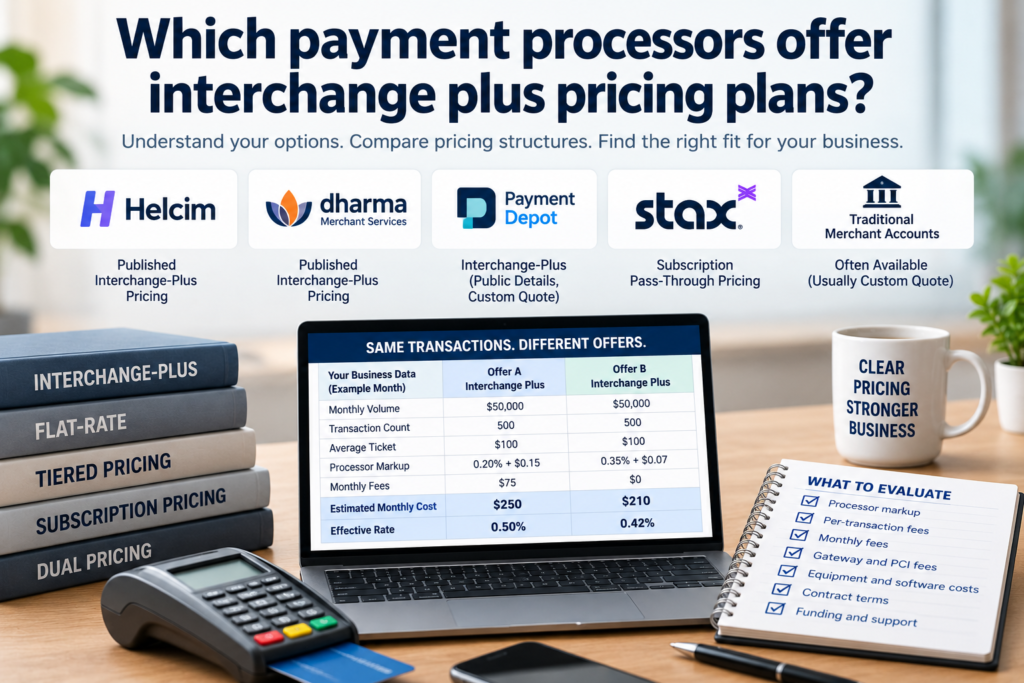
Merchants comparing payment processors often encounter phrases such as flat rate, tiered pricing, subscription pricing, and interchange plus.
Interchange-plus pricing is attractive because it separates the underlying cost of accepting a card from the processor’s own markup.
But finding out which payment processors offer interchange plus pricing plans is not as simple as looking at a list of company names.
Some processors publish their interchange-plus margins openly.
Others say they offer interchange-plus but require a custom quote.
Others use a related pass-through model where interchange is charged at cost but the processor earns money through a monthly subscription instead of a percentage markup.
Those are different structures, and they should not be compared as though they are identical.
Interchange-plus pricing separates the underlying card costs from the processor’s markup. A provider may charge interchange plus a disclosed percentage and per-transaction amount, but monthly, gateway, PCI, software, and other fees can still affect the total cost. Compare the complete pricing structure rather than the advertised markup alone.
Table of Contents
ToggleWhat is interchange-plus pricing?
Interchange-plus pricing separates payment-processing costs into underlying card costs and processor markup.
A simplified version looks like:
Interchange + processor markup
The processor markup is often expressed as:
a percentage + a per-transaction amount
For example:
Interchange + 0.30% + $0.10
The underlying interchange varies according to the card and transaction.
The 0.30% + $0.10 in this example is the processor’s disclosed markup.
That distinction is important because the markup is what you are actually comparing between interchange-plus providers.
For a broader explanation of the major pricing structures, see How to choose a credit card processor for a small business.
Interchange plus does not mean one fixed processing rate
A merchant on interchange-plus pricing does not necessarily pay the same total rate on every transaction.
One transaction might involve a debit card.
Another might involve a rewards credit card.
Another may be a commercial card.
Another may be entered online rather than accepted in person.
Those transactions can carry different underlying costs.
The processor then adds the agreed markup.
That is why interchange-plus pricing is primarily a transparency model, not a promise that every transaction will cost the same amount.
What do basis points mean?
Interchange-plus quotes are frequently expressed using basis points.
One basis point equals:
0.01%
Therefore:
10 basis points = 0.10%
20 basis points = 0.20%
30 basis points = 0.30%
100 basis points = 1.00%
Suppose a processor quotes:
Interchange + 30 basis points + $0.10 per transaction
That means:
Interchange + 0.30% + $0.10
If you process $50,000 in a month, the percentage portion of that markup would equal:
$50,000 × 0.30% = $150
But that is only half of the markup calculation.
You still need to account for the per-transaction fee.
Do not ignore the per-transaction markup
Merchants often focus on basis points because the percentage looks like the most important number.
For some businesses, the per-transaction amount matters even more.
Consider a $0.10 per-transaction markup.
On an $8 sale, $0.10 represents:
1.25% of the transaction
On a $500 sale, that same $0.10 represents:
0.02%
That is a dramatic difference.
A business with many small transactions should pay close attention to the per-item markup.
A business with large average tickets may be more affected by the percentage markup.
This is one reason it is impossible to rank interchange-plus processors accurately without knowing the merchant’s transaction profile.
Which payment processors offer interchange plus pricing plans?
There are several different ways providers currently offer interchange-plus or related pass-through pricing.
The useful distinction is not “best versus worst.”
It is:
Who publishes the pricing, who requires a quote, and what form of pass-through pricing are they actually offering?
Helcim: published interchange-plus pricing
Helcim is one of the clearest examples of a provider currently publishing a complete interchange-plus margin schedule directly on its website.
As checked September 3, 2026, Helcim publishes different margins based on monthly processing volume and transaction channel.
For merchants processing $0 to $50,000 per month, its published markup is:
In person: Interchange + 0.40% + $0.08
Keyed and online: Interchange + 0.50% + $0.25
The published margins decrease automatically at higher volume levels. Helcim says it calculates the applicable tier using the merchant’s average processing volume over the previous three months.
Helcim’s current U.S. fee disclosures also explicitly state that interchange, association fees, network fees, and other wholesale card costs are passed through and that Helcim adds its percentage and per-transaction margin.
This makes Helcim useful as an example of fully published interchange-plus pricing.
It does not automatically make it the least expensive option for every merchant.
You still have to apply the numbers to your own transaction data.
Dharma Merchant Services: published interchange-plus pricing
Dharma currently publishes interchange-plus pricing on several of its own industry pages.
Its current small-business and retail page states a margin of:
0.15% + $0.08 per transaction above interchange for storefront processing.
Its B2B pricing page currently lists:
0.20% + $0.11 per authorization for Visa, Mastercard, and Discover, along with a monthly fee, and says interchange and card assessments are passed through at cost.
Dharma also publishes a separate high-volume program with lower margins for qualifying businesses.
The important lesson is that pricing can vary by merchant type, channel, and program even within the same provider.
Do not assume a single number represents every account that provider offers.
Payment Depot: interchange-plus with part of the pricing by quote
Payment Depot currently describes its pricing as interchange-plus on its own website.
Its pricing page states:
0% percentage markup on interchange
along with published per-transaction charges of:
$0.08 card present
and
$0.15 card not present
while directing merchants to sales for the full commercial arrangement.
That makes it different from a provider publishing one complete all-in plan with every fixed monthly cost visible before contact.
The transaction structure is publicly described, but a merchant should still request the complete written schedule before trying to compare it with another offer.
Stax: subscription-based pass-through pricing
Stax should not be treated as identical to a traditional interchange-plus provider quoting basis points.
Stax describes its model as subscription pricing.
Its documentation states that merchants pay the direct cost of interchange rather than a percentage markup, while Stax earns through a monthly subscription and per-transaction charges. Stax currently advertises subscription pricing starting at $99 per month.
Economically, that is still a form of pass-through pricing.
But the math is different.
Traditional interchange-plus might be:
Interchange + 0.30% + $0.10
A subscription model might instead be:
Interchange + per-transaction fee + monthly subscription
One concentrates processor revenue in percentage markup.
The other moves much of that processor revenue into a fixed monthly charge.
You have to model both structures against the same merchant data to determine which costs less.
Traditional merchant-account providers and ISOs
Interchange-plus is also widely available through traditional merchant-account providers, banks, and independent sales organizations using acquiring platforms such as Fiserv, TSYS/Global Payments, Elavon, Worldpay, and others.
The complication is that the acquiring platform does not necessarily determine the merchant’s pricing model.
Two merchants can ultimately process through the same underlying platform while receiving completely different pricing structures from different sales organizations.
One may receive interchange-plus.
Another may receive tiered pricing.
Another may receive a custom arrangement.
These offers are generally quote based.
That is not inherently a problem.
A custom quote can account for processing volume, transaction channel, business type, risk profile, average ticket, and other factors.
The important requirement is that the final pricing be complete and in writing.
Published pricing and custom quotes are not the same thing
A provider that publishes its markup allows you to begin modeling costs without speaking with sales.
That is useful transparency.
But custom pricing is not automatically a red flag.
Some businesses legitimately require individual underwriting and pricing.
This is especially true for businesses with unusual transaction sizes, higher processing volume, delayed fulfillment, recurring billing, elevated chargeback exposure, or industries that require specialized underwriting.
For more on that distinction, see Which payment processors specialize in high risk merchant accounts?
The problem is not that a quote is customized.
The problem is when the quote is incomplete.
What should an interchange-plus quote include?
Before comparing offers, get the complete pricing structure in writing.
You should know:
- percentage markup above interchange
- per-transaction markup
- whether card-present and online transactions have different markups
- monthly account fees
- gateway fees
- PCI-related fees
- statement fees
- batch fees
- annual fees
- monthly minimums
- chargeback fees
- equipment costs
- software costs
- contract term
- termination provisions
- funding schedule
- any required additional modules
Also ask directly:
Are interchange and card-network fees passed through at cost without additional markup?
An interchange-plus quote is only useful if you understand exactly what the plus represents.
How to compare two interchange-plus offers
Suppose Provider A quotes:
Interchange + 0.20% + $0.15
Provider B quotes:
Interchange + 0.35% + $0.07
Which is cheaper?
You cannot answer from those two lines alone.
You need volume and transaction count.
Assume a business processes:
$50,000 per month
across:
500 transactions
Provider A
Percentage markup:
$50,000 × 0.20% = $100
Transaction markup:
500 × $0.15 = $75
Total processor markup before fixed fees:
$175
Provider B
Percentage markup:
$50,000 × 0.35% = $175
Transaction markup:
500 × $0.07 = $35
Total processor markup before fixed fees:
$210
Provider A is cheaper in this example.
But now change the transaction count while keeping volume the same.
If the business processes thousands of smaller transactions, Provider A’s larger per-item fee becomes increasingly important.
The result can flip.
That is why basis points alone do not determine which interchange-plus provider costs less.
For the complete same-month comparison method, see Compare credit card processing fees for small business accounts.
Fixed monthly fees can change the result again
Now imagine Provider A also charges:
$75 per month
while Provider B has:
no monthly account fee
Provider A’s modeled cost becomes:
$250
Provider B remains:
$210
The provider that appeared cheaper based solely on transaction markup is now more expensive.
This is why interchange-plus offers should be evaluated as:
Percentage markup + per-item markup + fixed costs + required services
not simply:
Who has the lowest basis points?
Card mix still affects your total cost
Even if two businesses receive the exact same interchange-plus markup, they may have different effective rates.
Why?
Because interchange underneath the markup varies.
One merchant may receive mostly lower-cost debit transactions.
Another may accept mostly rewards cards.
Another may process commercial or international cards.
The processor markup can be identical while the total processing cost differs.
That does not necessarily mean one merchant received worse pricing.
It means their underlying transaction mix is different.
Your merchant statement is where you can see those differences.
For the full statement-reading method, see How can I read and understand my merchant statement?
Interchange-plus does not eliminate downgrades
Another misconception is that moving to interchange-plus somehow prevents expensive transaction categories.
It does not.
Transactions can still qualify for higher interchange based on how they are accepted and processed.
Interchange-plus simply makes those underlying categories more visible.
That visibility can actually be useful.
If a large portion of transactions consistently falls into unnecessarily expensive categories, the answer may be operational.
Changing settlement behavior, transaction information, or payment workflow can sometimes matter more than changing processors.
How should interchange-plus appear on a merchant statement?
A transparent interchange-plus statement should generally make the major layers identifiable.
You should be able to see something resembling:
Interchange detail
Individual network categories, transaction counts, volume, percentage rates, and per-item costs.
Network fees and assessments
Separate card-brand charges.
Processor markup
A consistent percentage and per-item amount corresponding to your agreement.
Fixed service fees
Monthly charges, gateway fees, software, PCI services, or other account costs listed separately.
Exact layouts vary.
The important point is that you should be able to distinguish the underlying card costs from the processor’s own compensation.
If you cannot, ask the processor to walk you through the statement line by line.
Which businesses may benefit from interchange-plus pricing?
Interchange-plus may deserve serious consideration for businesses with:
- significant processing volume
- large average tickets
- debit-heavy transaction mixes
- stable card-present processing
- B2B or commercial-card transactions
- merchants who actively review their statements
- businesses that want visibility into processor markup
But those are profiles to investigate, not automatic rules.
There is no universal monthly volume where every merchant should move to interchange-plus.
When interchange-plus may not be the best fit
Interchange-plus is not automatically the right answer.
A low-volume business may find that fixed account expenses outweigh any benefit from a smaller percentage markup.
A merchant with very small average tickets may be more affected by per-item charges.
A seasonal business may dislike paying monthly fixed costs during slow periods.
Another business may value a tightly integrated flat-rate platform because it handles POS, invoicing, ecommerce, and operations with very little complexity.
And switching itself can have costs.
If you currently use Square, see How to switch from Square to another payment processor before assuming a pricing difference justifies moving.
For more complex Stripe integrations, see How to switch from Stripe to another payment processor easily.
Hardware, recurring billing, integrations, customer payment credentials, funding, and support can matter more than a small difference in markup.
The lowest interchange-plus markup is not necessarily the best offer
The best comparison is not:
Who has the lowest basis points?
It is:
What would each complete offer cost my business using my actual transactions?
Then ask:
- Is the contract reasonable?
- Does the processor support my business model?
- How reliable is funding?
- Are reserves involved?
- Does the gateway support my workflow?
- Is hardware portable?
- What happens if I need help?
- What does switching cost?
A processor can win the pricing calculation and still lose the business decision.
Likewise, your current processor may already be competitively priced.
If you want another set of eyes on how your current statement compares with a written interchange-plus proposal, you can request a merchant statement review through iTrust Merchant. The useful outcome may be identifying a meaningful difference, or confirming that changing processors would not improve the situation enough to justify moving.
Explore more merchant services resources for small businesses on BetterBizTools.
Common mistakes when comparing interchange-plus providers
- Comparing basis points and ignoring the per-transaction fee.
- Comparing interchange-plus markup with a flat-rate processor’s all-in price.
- Forgetting monthly, gateway, software, and equipment fees.
- Assuming interchange-plus guarantees savings.
- Trusting an old comparison article instead of checking the provider’s current pricing.
- Ignoring transaction count and average ticket.
- Assuming all interchange-plus providers quote the same markup for every channel.
- Failing to confirm that network costs are actually passed through without padding.
- Ignoring contract and termination terms.
- Ignoring underwriting fit.
- Forgetting migration costs.
- Switching for a small pricing difference that does not materially improve the business.
Want the full merchant processing guide?
This article covers one part of the payment-processing picture. iTrust Merchant’s free guide brings the major questions together in one place so you can better understand pricing, fees, merchant statements, processor choices, account holds, and other issues that can affect your business.
→ Download the Free Merchant Processing Guide
FAQ
What is interchange-plus pricing?
Interchange-plus pricing passes through the underlying card transaction costs and adds a separately disclosed processor markup, usually expressed as a percentage plus a per-transaction amount.
What does interchange plus 30 basis points mean?
Thirty basis points equals 0.30%. An offer of interchange plus 30 basis points means the processor adds 0.30% to the underlying interchange cost, usually along with a separately stated per-transaction markup.
Which payment processors publish interchange-plus pricing?
As checked September 3, 2026, Helcim and Dharma Merchant Services both publish interchange-plus margins on their own websites. Other providers may offer interchange-plus or related cost-plus structures through custom pricing or subscription models.
Is interchange-plus always cheaper than flat-rate pricing?
No. Total cost depends on processing volume, transaction count, average ticket, card mix, transaction channel, markup, and fixed monthly costs.
What is the difference between interchange-plus and subscription pricing?
Traditional interchange-plus adds a percentage and usually a per-transaction markup above interchange. Subscription pricing may pass interchange through without a percentage markup and instead charge a fixed monthly membership plus per-transaction fees.
How do I compare two interchange-plus quotes?
Apply both complete pricing schedules to the same representative month of your own processing data. Compare percentage markup, per-item charges, fixed fees, required services, and total modeled monthly cost.
Does interchange-plus eliminate expensive interchange categories?
No. Interchange-plus makes underlying transaction costs more visible, but transactions can still qualify for higher interchange categories.
How should interchange-plus appear on my merchant statement?
The statement should allow you to distinguish interchange, card-network fees, processor markup, and fixed account or service charges. Exact layouts vary by processor.
Can Square or Stripe use interchange-plus pricing?
Their standard small-business offerings are generally structured differently from traditional interchange-plus merchant accounts. Large or custom arrangements can differ, so merchants should verify current terms directly with the provider rather than assuming a standard published rate applies.
Should I switch processors just to get interchange-plus pricing?
Not necessarily. Compare the total modeled cost and also consider contracts, funding, integrations, underwriting, hardware, support, reserves, and migration costs.
About the author
Lindsey Harris works in merchant services and helps business owners better understand payment processing, merchant statements, processing costs, and provider options. He is the founder of iTrust Merchant, where businesses can request a written second opinion on their merchant processing statement.