
When a payment service provider “freezes” a business account, the first question should not be:
Why are they holding my money?
The first question should be:
What kind of restriction did they actually place on the account?
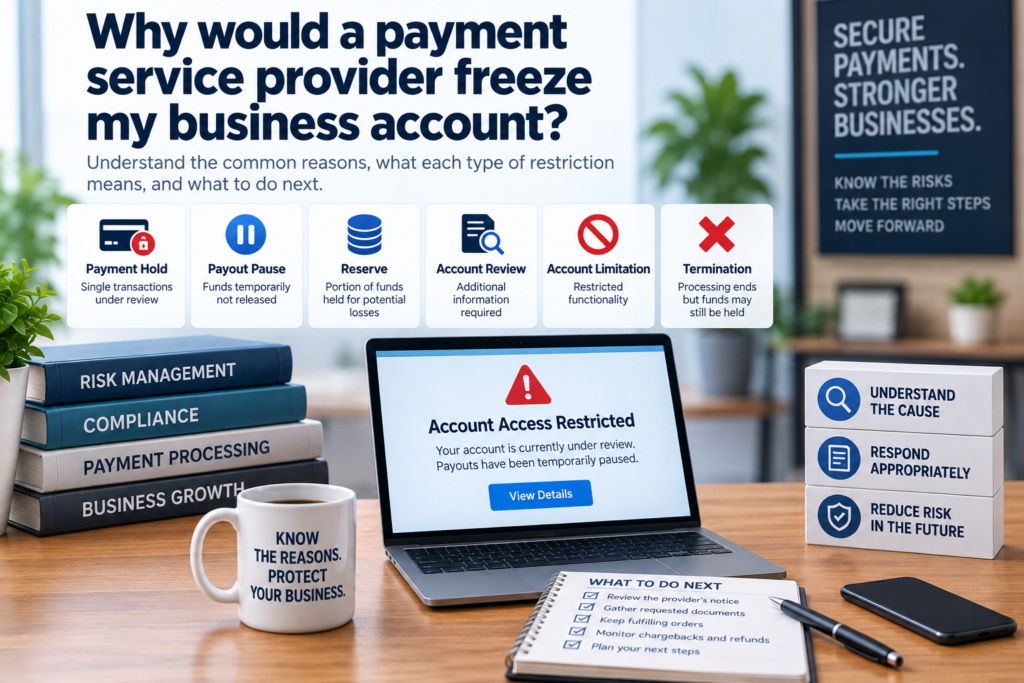
Merchants often use the word freeze for several different situations:
- a payment-level hold
- a payout pause
- a reserve
- an account review
- an account limitation or suspension
- full termination
Those are not the same thing.
They can have different causes, different timelines, and different remedies.
Understanding which one you are dealing with is the fastest way to determine what to do next.
A payment service provider may freeze or restrict a business account because of fraud or security concerns, sudden changes in processing volume, increased chargebacks or refunds, verification issues, prohibited activity, or higher financial risk. A “freeze” can mean a payout hold, reserve, account review, suspension, or termination, so the first step is identifying exactly what restriction was applied.
Table of Contents
ToggleWhat does an account freeze actually mean?
A payment provider may restrict funds or account activity for several reasons.
The restriction is usually a risk-control mechanism.
That does not automatically mean the merchant did something wrong.
It also does not mean every restriction is necessarily reasonable.
The provider may be reacting to fraud signals, transaction changes, chargebacks, verification problems, business-model risk, or potential future liability.
The specific mechanism matters.
Payment-level hold
A payment-level hold usually applies to a particular transaction or small group of transactions.
The rest of the account may continue operating normally.
For example, a provider may review one unusually large sale before making those funds available.
This is narrower than a full account restriction.
Payout pause
A payout pause means the merchant may still be able to accept payments, but the provider temporarily stops transferring money to the linked bank account.
Possible causes include:
- incomplete verification
- a bank-account problem
- negative balance recovery
- risk review
- suspicious activity
- pending disputes
- regulatory or legal requirements
Square’s current Payment Terms explicitly allow it to defer payouts or restrict access to proceeds while investigating suspected fraud, unauthorized transactions, disputes, legal issues, or activity that may present risk.
Reserve
A reserve is different from a freeze.
A reserve means the provider keeps part of the merchant’s funds available to cover possible future chargebacks, refunds, or other losses.
The account may continue processing normally.
Square describes reserves as an industry practice used to make sure merchants can cover disputes, and says factors may include prepayment, chargeback history, irregular processing activity, and being new to Square.
Square also says reserve terms include a duration period, and accounts with reserves are reviewed after a minimum of six months.
A reserve is therefore not necessarily a punishment.
It is a way of pricing or controlling risk.
Account review
An account review means the provider is examining the business or account activity.
The merchant may be asked for:
- identification
- business formation documents
- bank statements
- proof of address
- proof of bank ownership
- invoices
- fulfillment records
- information about products or services
- processing history
The account may remain partially functional during the review.
In other cases, payouts or new charges may be restricted until the review is completed.
Account limitation or suspension
A limitation or suspension is broader.
The provider may block:
- new payments
- withdrawals
- payouts
- certain account features
The remedy depends on the underlying reason.
A missing verification document may be fixable.
A prohibited-business determination may not be.
Termination
Termination means the provider ends the processing relationship.
New processing stops.
But the provider may still retain funds temporarily because liability from previously processed transactions can continue after closure.
That can include:
- refunds
- chargebacks
- reversals
- fees
- unresolved disputes
Square’s current terms say termination does not eliminate obligations involving fees, chargebacks, or other amounts owed.
So closure and fund release are separate issues.
Why would a payment service provider freeze my business account?
Most restrictions fall into several broad categories.
1. Fraud or security signals
Providers constantly monitor transactions for unusual or suspicious behavior.
Possible triggers include:
- sudden bursts of small transactions
- high decline rates
- suspected card testing
- unexpected international activity
- unusual login behavior
- mismatched customer information
- sudden fraud complaints
Some of these events can happen even when the merchant is legitimate.
For example, a bot attack against an ecommerce checkout can generate card-testing activity without the merchant intentionally doing anything wrong.
The provider still has to react because its financial exposure is real.
2. Your business no longer matches what was originally approved
This is one of the most preventable causes.
A merchant may have opened the account describing one business and later changed:
- products
- pricing
- sales channel
- average ticket
- monthly volume
- fulfillment timing
- subscription model
- website
- ownership
The provider approved one risk profile.
It is now seeing another.
That can trigger new underwriting.
A fast-growing business can therefore create a risk review even when growth itself is legitimate.
3. Sudden volume or ticket-size spikes
Payment providers often evaluate an account against expected monthly volume and average transaction size.
Suppose an account normally processes:
$20,000 per month
with a:
$75 average ticket
Then it suddenly processes:
$80,000
with multiple:
$5,000 transactions
That changes the provider’s exposure dramatically.
A larger transaction creates a larger possible future chargeback.
A large volume spike creates more total outstanding liability.
This does not necessarily mean the transactions are fraudulent.
It means the actual activity no longer looks like the account the provider originally evaluated.
4. Chargebacks, refunds, or customer complaints increase
Chargebacks are one of the clearest risk signals.
If customer disputes begin rising, the provider can respond by:
- delaying payouts
- increasing reserves
- imposing new restrictions
- requesting documentation
- suspending processing
- terminating the account
Square’s current Payment Terms explicitly say it may create a reserve, delay payouts, add restrictions, or suspend or terminate payment services if it believes a merchant has or is likely to have excessive chargebacks.
Refund spikes also matter.
High refunds can indicate:
- fulfillment problems
- product dissatisfaction
- cancellation issues
- billing confusion
- future chargeback exposure
The provider is looking at potential losses, not simply completed sales.
For more on how higher-risk accounts are evaluated, see Which payment processors specialize in high risk merchant accounts?
5. Restricted or prohibited business activity
A provider may allow certain business categories only after additional review.
Others may be prohibited entirely.
Stripe’s current restricted-business documentation explains that certain categories may be supported only after additional review and explicit approval, while illegal products and services are never eligible.
A merchant can therefore be approved quickly, begin processing, and later discover that the provider does not support the actual business model.
This can happen when the original application was too vague or when the business changed after onboarding.
If the business is genuinely outside the provider’s risk appetite, repeatedly appealing may not solve the problem.
The more durable solution is finding an account structured for the actual business.
6. Identity, ownership, or bank verification problems
Some account restrictions are much less dramatic than merchants assume.
The provider may simply need to confirm:
- who owns the business
- whether the business exists
- whether the bank account belongs to the business
- whether the address matches
- who the beneficial owners are
Square’s underwriting guidance says it may review financial information and that complete, accurate information helps avoid delays or unexpected risk mitigation.
A mismatch can create problems even when all of the underlying information is legitimate.
For example:
- application uses a DBA while the bank uses the legal entity name
- business moved but the provider still has the old address
- personal bank account is connected to a corporate entity
- ownership changed without updating the provider
- document names do not match the profile
The solution is usually accuracy, not argument.
7. Liquidity or future-delivery risk
Payment providers also care about what happens after a merchant receives the money.
Consider businesses that collect payment well before delivery:
- contractors taking deposits
- travel businesses
- event companies
- custom furniture businesses
- subscription services
- pre-orders
- high-ticket consulting
- education programs
If the business fails before delivering, customers may dispute transactions later.
That means the provider can still face financial exposure long after the original payment.
Square specifically lists prepayment for goods or services as one factor it considers when deciding whether to place a reserve.
The issue is not whether prepayment is legitimate.
It is the length and size of the provider’s outstanding liability.
Why Square, Stripe, and PayPal can feel different from a traditional merchant account
There is an important structural difference.
Platforms such as Square, Stripe, and PayPal make it possible for businesses to begin accepting payments quickly.
The tradeoff is that risk evaluation continues after the account begins processing.
Stripe says most account approvals happen almost instantly, but it may request more information or take longer when the business requires additional review.
That means a merchant may experience the underwriting process after money has already started flowing.
A dedicated merchant account typically conducts more underwriting before approval.
That can involve:
- processing statements
- bank statements
- business documentation
- average-ticket review
- volume review
- industry review
- reserve conditions
The tradeoff is straightforward:
faster onboarding versus more underwriting before processing begins
Neither model is automatically better.
The problem occurs when the business’s risk profile no longer fits the model it is using.
For the broader processor-selection framework, see How to choose a credit card processor for a small business.
What should I do immediately after my account is frozen?
First, do not assume the worst.
Identify what the provider actually told you.
1. Read the notice carefully
Look for words such as:
hold
reserve
review
payout pause
limitation
suspension
termination
The response depends on which one applies.
2. Export your records while you still have access
Save:
- transaction history
- payout records
- customer records
- dispute records
- statements
- correspondence
- invoices
- reports
If you use Square, see How to switch from Square to another payment processor for the migration and account-preservation steps.
If you use Stripe, see How to switch from Stripe to another payment processor easily.
3. Send exactly what the provider requests
If the provider asks for:
three bank statements
send three bank statements.
If it asks for:
proof of fulfillment
send fulfillment evidence.
If it asks for:
business formation documents
send the matching documents.
Do not flood support with unrelated material.
Do not alter the business description to make it sound safer.
Accuracy matters.
4. Continue fulfilling legitimate orders
Stopping fulfillment can make the problem worse.
Customers who stop receiving products or services may file disputes.
Those new disputes can increase the provider’s risk assessment.
5. Continue responding to chargebacks
A processing relationship ending does not make the previous transactions disappear.
Disputes may still arrive.
Keep monitoring and responding while the account remains accessible.
6. Document everything
Maintain a timeline containing:
- the original notice
- date of restriction
- documents requested
- documents submitted
- provider responses
- appeal communications
- payout changes
- final resolution
If significant money is involved, organized documentation becomes extremely important.
Do not open another account under a different business name
This is one of the worst responses to an account restriction.
Do not create another processor account under:
- another DBA
- a different company name
- another owner
- a slightly altered website description
for the purpose of hiding the underlying business.
That does not solve the risk issue.
It can create a much more serious underwriting problem.
Likewise, do not process transactions through another company’s merchant account.
The replacement account should be underwritten honestly for the actual business.
Do not close the old account in anger
Closing an account immediately may remove access to tools you still need.
Those can include:
- transaction history
- refunds
- dispute responses
- reports
- customer information
- tax documents
A better approach is usually to migrate processing volume while preserving access to the old account when possible.
That is the same principle covered in the Square and Stripe switching guides.
How long can payment providers hold funds?
There is no universal answer.
It depends on:
- provider
- type of restriction
- reason for the hold
- remaining refund exposure
- chargeback exposure
- applicable contract terms
- legal or regulatory requirements
PayPal
PayPal’s current U.S. Balance Terms say risk-based payment holds generally remain in place for up to 21 days.
PayPal also says a hold may last longer and can remain in effect for up to 180 days.
That is why merchants should not assume every PayPal restriction has the same timeline.
Square
Square’s current terms permit payout delays and reserves but do not establish one universal post-restriction hold period for every situation.
That is important because internet claims such as:
“Square always holds money for 90 days”
should not be presented as official policy.
The actual reserve or hold terms depend on the account and situation.
Why are funds held after processing stops?
Because payment liability does not necessarily stop when new processing stops.
Customers may still:
- request refunds
- dispute transactions
- file chargebacks
- reverse payments
The provider may therefore retain enough money to cover potential remaining liability.
This does not mean the merchant should simply accept any decision without question.
It means there is a financial reason behind post-termination holds.
The practical goal is to understand:
what is being held, why it is being held, and what the agreement says about release.
Can a frozen account be reopened?
Sometimes.
It depends on the cause.
A verification issue may resolve when the requested documents are accepted.
A suspicious-activity review may clear.
A reserve may eventually be reduced.
But if the provider determines that the business itself is prohibited or outside its risk appetite, reinstatement may not be a realistic outcome.
That is why identifying the trigger matters so much.
How can I reduce the risk of an account freeze?
Many account restrictions can be made less likely through better setup and communication.
Describe the business accurately
Do not simplify the business description merely to get through onboarding.
Disclose:
- what you sell
- how you sell it
- typical ticket size
- fulfillment timing
- subscription terms
- expected monthly volume
The provider needs to approve the business you actually operate.
Tell the provider when your business changes
If you add:
- a new product line
- much larger transactions
- subscription billing
- international sales
- significantly more volume
update the provider.
An expected change is easier to evaluate than an unexplained anomaly.
Keep verification information current
Make sure:
- legal name
- DBA
- ownership
- bank information
- address
- website
remain accurate.
Monitor refunds and chargebacks
Do not wait until a provider raises the issue.
Your merchant statement can help you track:
- refunds
- chargeback fees
- processing volume
- changes in account costs
See How can I read and understand my merchant statement?
Use a provider that fits the business model
A simple, low-volume business may be perfectly suited to an aggregator.
A higher-volume merchant with:
- delayed fulfillment
- large tickets
- recurring billing
- elevated chargeback exposure
- specialized industry risk
may benefit from being fully underwritten before processing.
That does not mean every merchant should switch.
It means the payment setup should match the actual risk profile.
A freeze is a signal, not a diagnosis
So, why would a payment service provider freeze my business account?
Possible reasons include:
- fraud signals
- sudden volume changes
- unusually large transactions
- increasing disputes
- high refunds
- unsupported business activity
- verification problems
- negative balances
- future-delivery exposure
- regulatory or legal requirements
But the word freeze does not tell you which one applies.
Start by identifying the exact restriction.
Then respond to that specific issue.
A document problem should be treated like a document problem.
A chargeback problem should be treated like a chargeback problem.
A business-model mismatch should be treated like an underwriting problem.
And a prohibited-category determination should not be treated like a missing-document appeal.
That distinction gives the merchant a much clearer path forward.
Want the full merchant processing guide?
This article covers one part of the payment-processing picture. iTrust Merchant’s free guide brings the major questions together in one place so you can better understand pricing, fees, merchant statements, processor choices, account holds, and other issues that can affect your business.
→ Download the Free Merchant Processing Guide
Explore more merchant services resources for small businesses on BetterBizTools.
FAQ
Why would a payment service provider freeze my business account?
Common reasons include fraud signals, transaction spikes, increased chargebacks, high refunds, business-model changes, restricted activity, verification problems, or increased financial exposure.
Does a frozen account mean my account is permanently closed?
No. A hold, reserve, payout pause, or account review can be temporary. Termination is a separate action.
What is the difference between a reserve and a freeze?
A reserve holds a defined amount or percentage of funds against potential future liability while the account may continue operating. A broader restriction may stop payouts or processing entirely.
How long can PayPal hold my money?
PayPal’s current U.S. Balance Terms say risk-based holds generally last up to 21 days but may remain longer, up to 180 days in some circumstances.
How long can Square hold my money?
Square’s current terms permit payout delays and reserves but do not establish one universal duration that applies to every account restriction. The specific terms depend on the situation.
Why did my account get reviewed after my sales increased?
Rapid volume or ticket-size increases can create financial exposure that differs from the account’s original processing profile, causing the provider to review the activity.
Should I open another payment account under a different business name?
No. A replacement account should accurately disclose the same underlying business and ownership. Attempting to hide the business can make future underwriting more difficult.
Can chargebacks still affect held funds after my account is terminated?
Yes. Liability from transactions processed before termination can continue, and providers may use held funds to cover valid chargebacks, refunds, or other amounts owed under the account agreement.
Why do payment platforms review businesses after signup?
Some platforms allow merchants to begin accepting payments quickly and continue underwriting as transaction activity develops. That can cause additional review after the merchant is already processing.
Should I switch processors after a freeze?
Not automatically. First determine whether the cause was verification, fraud, transaction behavior, disputes, or a genuine mismatch between the business and the provider. The correct next step depends on the cause.
About the author
Lindsey Harris works in merchant services and helps business owners better understand payment processing, merchant statements, processing costs, and provider options. He is the founder of iTrust Merchant, where businesses can request a written second opinion on their merchant processing statement.